

Duke Leto Atreides: Diminished By Adaptation?
On Leto, what the films get right, and what they miss.

Preface
Thanks to Denis Villeneuve's adaptation, Dune was recently launched back into the popular consciousness for the first time in decades. If you like sci-fi, fantasy or anything in between, you were probably inundated with Dune-based content, video essays, memes, etc. for several months this year, thanks to the buzz generated by the release of Part 2.
As a huge fan of the book, having read it twice before the new adaptation was announced, and a third time more recently, I was pretty much the target audience for Villeneuve's Dune. Naturally, this also means that I came in with high hopes and preconceived notions of how Dune ought to be. I was not a hostile audience, but I must have been particularly hard to please compared to the average viewer. For the sake of balance, I think it's important to preface my comments on the new Dune with that context, and also to give credit to some of the new film's positive features before getting into my specific gripes.
The beauty of Villeneuve’s Dune
The new Dune has many merits - the captivating soundtrack, intricate props and costumes, and the effective use of fictional languages and terminology all do much to transport the audience to another era on a visual and sensory level. I was also very impressed with the action. The composed, economical movements of Dune's combatants do a very elegant job of conveying the intense martial training that is such a constant theme in the novel, and the focus on hand-to-hand combat, so integral to Herbert's book, adds an intimacy and intensity to the action scenes that we don't always see in sci-fi.
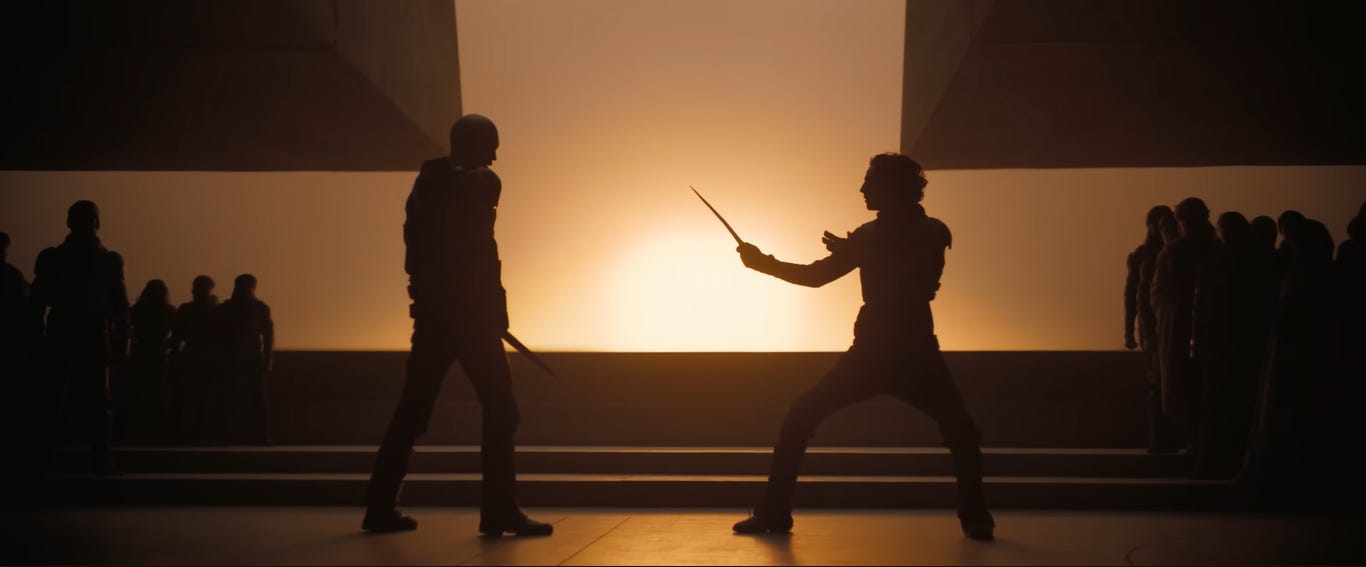
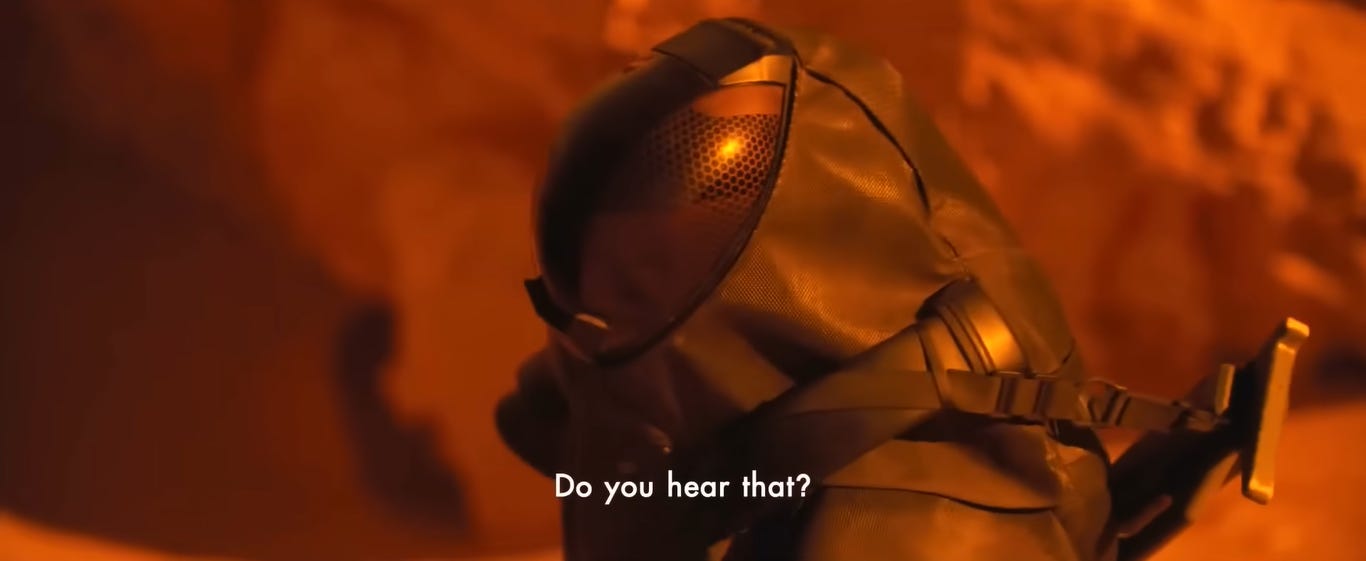
The new Dune's unique visual take on the practical mechanics of war and industry on Arrakis also appealed to the little boy part of my brain in a way that only really good sci-fi can. My reaction to the elegant dragonfly-like ornithopters, the hulking tick-like spice harvesters, and the sinister Harkonnen troopers was in the same category as my reaction to Rebel snowspeeders, Jawa Sandcrawlers, and Imperial Stormtroopers long ago.
The ugliness of Villeneuve’s Dune
There are shortcomings to the presentation as well, though. New Dune can get very desaturated in places, and the monotonous grey and black uniforms of the Atreides and Harkonnens, combined with armour that looks very generic and mass-produced (appropriate for the Harkonnens, less so for the Atreides) de-emphasises the feudal nature of the universe, and the peacocking that comes with that. In the book, the Atreides banner bears a red hawk on a green background, and this is how their uniforms are described. In the film, you’d be forgiven for thinking that it was a light grey hawk on a darker grey background.
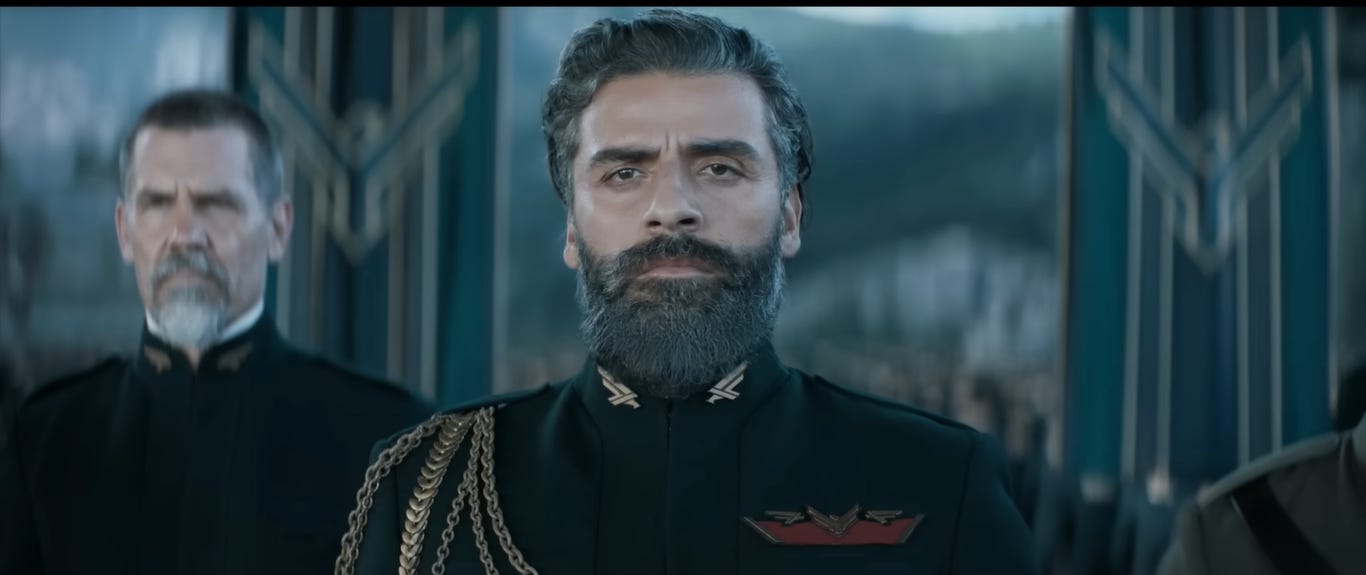
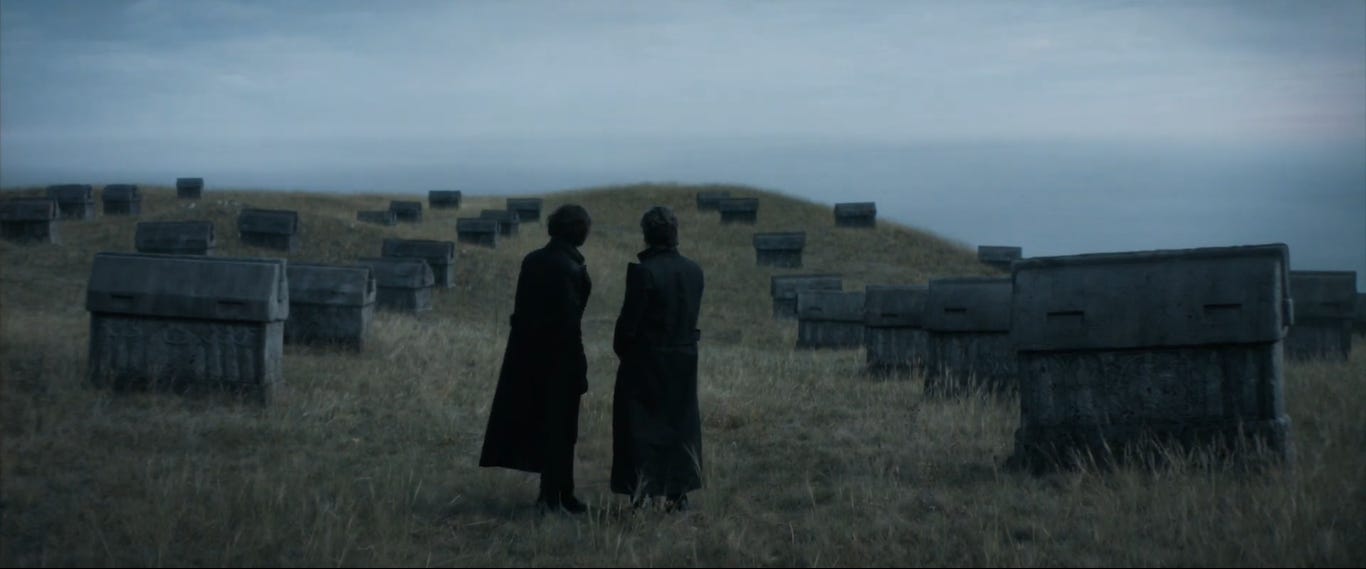
It's very, well, Game of Thrones-y - even today, House of the Dragon (GoT's successor) only very grudgingly lets medieval soldiers wear their lord's colours, and slaps a murky filter over everything to remind us that this is a (literally) dark program for grown-ups. Dune doesn't go so far, except maybe on Caladan, the Atreides home planet, which in the book is described as a verdant paradise producing rice as its main crop, yet resembles the Outer Hebrides in the film.
Missing monologues
Nitpicks aside, however, I found a lot to enjoy in the new Dune on a visual and technical level. My problems with the film stem more from shortcomings in writing and characterisation, which derive more often than not from streamlining and simplification of the source material. This process was always somewhat inevitable - considering the length, intricacy, and ambition of Dune's narrative, and the many political and social themes it deals with, a complete, definitive adaptation would be nigh impossible without extending the runtimes far, far beyond what would be acceptable to a modern audience. It would also be necessary to faithfully adapt many long expository dialogues that are fascinating to read, and do much to flesh out Herbert's unique universe, but wouldn't necessarily translate well to the screen.
David Lynch's Dune leaned more towards this, even including several characters' internal monologues in the form of whispered, ASMR-like voiceovers. While admittedly weird, this was not inappropriate in the context of Dune - so much of Herbert's narrative is delivered via the minute observations and private reflections of its elite fighters and calculating aristocrats. Of course, Lynch's Dune was rinsed brutally by critics at the time, to the point that even its creator has now disowned it, and it remains something of a lolcow even today (perhaps not altogether deservedly), so it would be extremely unlikely to see any later adaptation offering voiced internal monologues.
Lost epigrams
Moreover, the new adaptation inevitably suffers from the omission of the book's many epigrams, which preface each chapter. These epigrams are not only valuable pieces of worldbuilding in their own right, but are vital in terms of contextualising the contents of each chapter, providing background on characters and events.
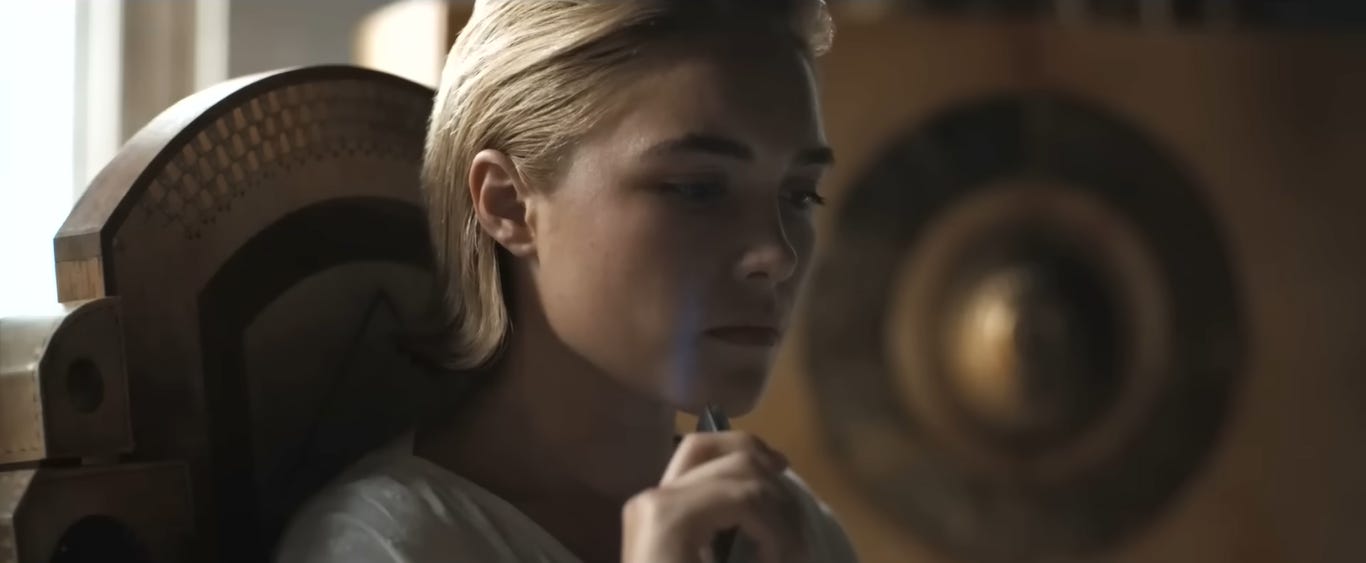
Their absence from adaptations is felt (by me, at least), and it contributes to a key narrative difference between Dune on the page and Dune on the screen - because the epigrams are taken from in-universe history books and religious texts, they inform us from the beginning of Paul's rise to power, and thereby heighten our sense of intrigue through dramatic irony, causing the reader to share Paul's imperfect prescience.
This leads to a sense of inevitability throughout, which is such a key part of Dune's pessimistic, deterministic central thesis - its protagonists are prisoners of history, struggling vainly against forces beyond their control. Part 2 does nod to these epigrams with Irulan's recorded narrations, but these are much narrower in scope, serving more as an expository commentary on current events.
Of course, it's clear why the epigrams had to be omitted - film is not literature, and it would be very difficult to integrate elements like these without sacrificing tension and slowing the narrative to a snail's pace. Nevertheless, their loss diminishes the complexity of the characters, which is often exacerbated by less justifiable changes and omissions.
'Surpassing warmth and surprising coldness'
One particularly important supporting character who has suffered considerably from adaptation is one of my favourites in the book: Duke Leto Atreides. Leto is, of course, absent from Part 2, on account of death by poison tooth, but is there in spirit, at least in terms of his children, his family name (soon to be dragged through the mud), and his legacy.
To put it simply, my complaint is this: film Leto, like his predecessor in Lynch's version, is simply 'the good father' whose role is to set a good example and then die. Book Leto, on the other hand, is a far more complex, ambiguous, and altogether superior creature, who I wish we had seen more of.
Having touched on the epigrams in Dune above, I think it's helpful to quote here the one that introduces Duke Leto at the head of the chapter where he makes his first appearance:
'How do we approach the study of Muad'dib's father? A man of surpassing warmth and surprising coldness was the Duke Leto Atreides. Yet, many facts open the way to this Duke: his abiding love for his Bene Gesserit lady; the dreams he held for his son; the devotion with which men served him. You see him there - a man snared by Destiny, a lonely figure with his light dimmed behind the glory of his son. Still, one must ask: What is the son but an extension of the father?'
This whole epigram is excellent, very efficiently establishing the character's defining features. In fairness to Villeneuve, many of these were adapted effectively: Leto's warmth and his love for Paul and Jessica survived the translation, as did his charisma as a leader. However, key features were also lost: we see very little of the darker side of his nature, and nor do we learn much about his outlook, insights, and the wider circumstances that lead to his fate on Arrakis.
The cold-blooded aristocrat
So, what exactly is meant by Leto's 'surprising coldness'? This element to his character is not even hinted at in Villeneuve's version, nor in Lynch's. However, Herbert's Leto does live up to his billing in several respects. Notably, his relationship with his mistress, his son, and his subordinates are all subtly coloured by his elite status as a man of royal blood and the head of his household. Jessica addresses Leto as 'my lord' on several occasions even in private conversation. The first dialogue between the two is immediately after their arrival on Arrakis, and the scene is permeated by high tension and anxiety; it is apparent that with this mood and context, Jessica defaults to addressing her lover formally, even after he asks her not to.
Moreover, although Herbert does not go into this in detail, we are reminded of how their relationship was established as Leto reflects on how she was first described to him by his 'buyers', who visited the Bene Gesserit on his behalf to acquire a concubine. Contextually, it's quite clear that this is very normal among the Imperial aristocracy - after all, what better way is there for the Bene Gesserit to manipulate bloodlines and gain access to power?
Still, Herbert's word choice in relation to Leto and Jessica is illuminating - talk of 'buyers' places heavy emphasis on the calculating, transactional nature of their early relationship, which is further brought out in the surrounding passage. Leto considers Jessica's features 'more regal than the Emperor's own blood', and is pleased that she has re-introduced this 'regal' beauty to his family's bloodline. Although this is obviously in part just a normal attraction to the lovely Jessica, there is also an implication that she was selected for her particular features, with the desired royal image of the Duke's future children in mind.
The 'ick' factor
To the average reader, it's rather unpleasant to think of human beings breeding in such a deliberate and purposeful way, yet this is typical of Dune's aristocracy. This unpleasantness, Frank Herbert's trademark 'ick' factor around reproduction, is an essential ingredient to his worldbuilding and narrative - the Bene Gesserit are not evil because they wear black and speak in scary voices, per the film, but because they are manipulating bloodlines in a clinical way, selectively breeding humans like animals and even arranging incestuous pairings to achieve their obscure goals.
The fact that Leto seems to think in similar terms, although not to such extremes, doesn't necessarily speak well of him. Moreover, it is evident that Leto, despite whatever other good qualities he may have, is not above quite literally buying a woman, albeit in a fairly specific and (in his world) socially acceptable context.
Moreover, the purposeful and calculating nature of Leto in his choice of partner can further be seen in how it relates to his wider political agenda - we learn that he chose to take a Bene Gesserit concubine, rather than to form an alliance through marriage with another noble family, because by remaining unattached he could more easily cultivate alliances with families who might hold out hope of a political match (i.e. string hopefuls along for political gain).
The possibility of Leto marrying Irulan, the Emperor's daughter, and thus becoming his heir (as Paul does), is never discussed in the book, yet seems another good reason for Leto to remain unattached. Also, the desire for children with a 'royal' appearance likely relates to Leto's rivalry with his relative the Emperor, who he was poised to supplant before the beginning of the book (more on this below). Although it is made clear that their relationship has grown into a loving and genuine one, it certainly has a complicated foundation, rooted in alien (and, to the reader, distasteful) cultural norms, and in Leto's cold, purposeful decision-making.
Features and manner
The reactions of Paul and Jessica to Leto's appearance and presence are also illuminating, highlighting the harder elements of his personality:
'The Duke was tall, olive skinned. His thin face held harsh angles warmed only by deep grey eyes.'
'the face was predatory: thin, full of sharp angles and panes. A sudden fear of him tightened her breast. He had become such a savage, driving person since the decision to bow to the Emperor's command.'
[In this scene, Jessica is also uncomfortable under the intensity of Leto's observation]
Kynes also considers him to be 'hawk-featured' in appearance, a descriptor that is also applied to the sadistic Mentat Piter de Vries. Kynes also observes that the sheaths of Paul and Leto's weapons appear to be well worn by use, and is impressed by the two's 'strange combination of softness and armed strength' (a definite echo of Leto's conflicting warmth and coldness, from the earlier quotation). Leto is elsewhere characterised by his rumpled, well-worn uniforms and the patina of frequent use on his shield belt, indicating his constant proximity to danger and violence.
Domestic hierarchies
In a subtle yet important parallel with his earlier conversation with Jessica, another book-only exchange between Leto and Paul is also characterised by a stiff formality on the part of Paul, the junior and subordinate in the relationship. In this chapter, Leto explains to Paul that he (Leto) must pretend to suspect Jessica of treachery, in order to mislead his enemies. Leto is exhausted and dismayed, and hates himself for what he is doing, and Paul unsuccessfully tries to talk him out of it, knowing that his mother will be hurt by the deception.
Throughout the discussion, Paul addresses his father formally as 'sir', in stark contrast to their earlier exchanges, in which they speak informally as father and son with no form of address. It is evident that in moments of high tension, Leto's concubine and son address him formally, a mark of the rigid social hierarchies that characterise the setting, and persist even within relatively humane noble families such as the Atreides. It's also worth noting that he is said to have a habit of speaking harshly and 'disdainfully' to servants when he is in a hurry. For all his positive traits, and his dislike of the Imperial system (see below), he is still very much a part of that system and acts out its norms and values in his daily life.
What Villeneuve missed
This is, of course, emphatically not what was depicted by Villeneuve. In the new Dune, Paul addresses his father as 'dad', a jarringly affectionate and modern-sounding word that is unsurprisingly absent from the text of the novel. More importantly, Villeneuve's Leto actually gives Paul a choice about his future (the very thing that no-one in Imperial society has, least of all the son of a Duke), and whether he wants to become Duke or not, confiding that he also had his doubts, and expressing unconditional love for his son.
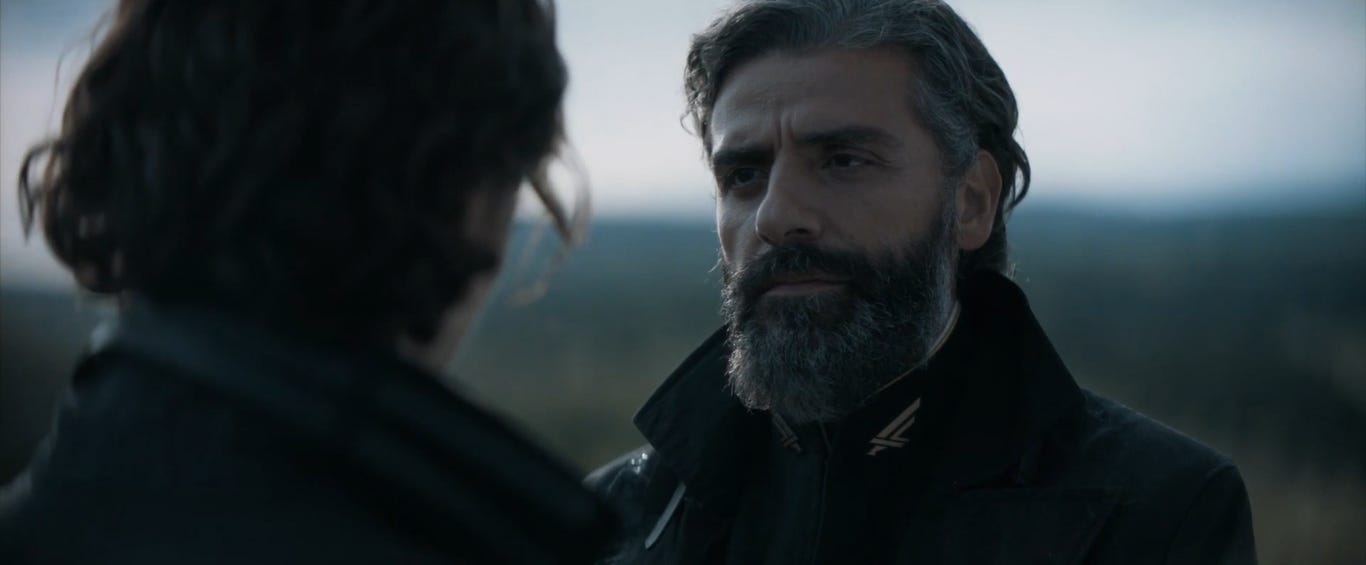
This is a nice message for parents in the 2020s, but frankly bonkers in the context of Dune's universe and Leto's character. Think about his incredibly ancient and exalted bloodline, his careful selection of a suitable partner from an elite institution, his fifteen year and counting investment in training up his sole heir with the help of the finest swordsmen and spymasters in the universe, and his apparent lack of any other suitable relatives. What, we have to wonder, does Villeneuve's Leto intend to happen to the dukedom if Paul abdicates? How would it impact their subjects, and the balance of power in the Landsraad (the ruling council)? Could he really be so irresponsible?
It's baffling, and I get the distinct feeling that the audience wasn't intended to think too hard about this dialogue, or about how little sense it makes in the context of a feudal society - we are just supposed to think how nice Leto is. It's effective, largely because of Oscar Isaac's performance and Hans Zimmer's soundtrack, yet I can't help but feel that there must have been other ways in which they could have shown Leto to be nice, ways which wouldn't undermine at the outset the whole premise and foundation of this setting (i.e. the concept of a strict feudal society in space).
Moreover, the basis of the conversation, the idea that Paul wouldn't want to be Duke, is beyond dubious, given that he has been trained for that purpose for his entire life, greatly values the dignity of his family name, and clearly seeks the approval of his parents and teachers. In the book, there could never be any question of him refusing to accept the Dukedom.
Damage to Paul's character
In the book equivalent to this early conversation between Paul and Leto, Leto reveals that his son has Mentat potential (Mentats are human savants who can process information like computers), and has been being secretly trained to cultivate this ability since infancy. Leto explains that Paul has reached a crucial point, and must decide whether he wants to continue the training. The scene has a similar effect, in that Leto is shown to be caring and humane - he's willing to give his son as much time as he needs to decide, and does not wish to pressure him. However, we also see that Leto is a person of foresight and calculation, who has been working to give every possible advantage to his heir for many years.
The scene also helps to establish Paul's decisiveness and commitment to his House, as he immediately consents to continue the training. Compared to the soft, seemingly aimless rich kid Paul depicted by Villeneuve, Herbert's Paul is a far more driven and formidable figure even this early in the story, and so his rise to power is ultimately much more believable. Book Paul also displays much more agency later on, taking it upon himself to drink the Water of Life rather than being manipulated by [checks notes] the Force ghost of Jamis (of all people) and his now inexplicably evil mother.
Relatability over immersion
We see a similar issue (but, honestly, worse) with the depiction of Chani, who is pretty much just a modern girl, and often a proxy for the director - she doesn't sound or act like a Fremen (every other Fremen speaks with an accent or in their own language; Chani just sounds like Zendaya); she somehow sees through the lies of the Bene Gesserit despite having no way of knowing about the Bene Gesserit's activities on Arrakis; she rejects prophecy, probably on the basis of it being Bene Gesserit (which she simply shouldn't know); and she is a secular Fremen nationalist rather than a religious tribal nomad like every Fremen in the book.
The latter is explained as a difference between northern and southern 'fundamentalist' (a loaded term if ever there was one) Fremen, yet the two share an identity, culture, way of life, religion, and common enemy, so it's hard to imagine a meaningful reason for this distinction, other than 'we wanted Chani to be relatable and to know better than those scary-looking men with beards'. On the Bene Gesserit issue, Chani's belief about them happens to be true, but would resemble a lunatic conspiracy theory to any ordinary Fremen, none of whom would ever have left Arrakis or know anything about the activities of the Bene Gesserit in the wider universe.
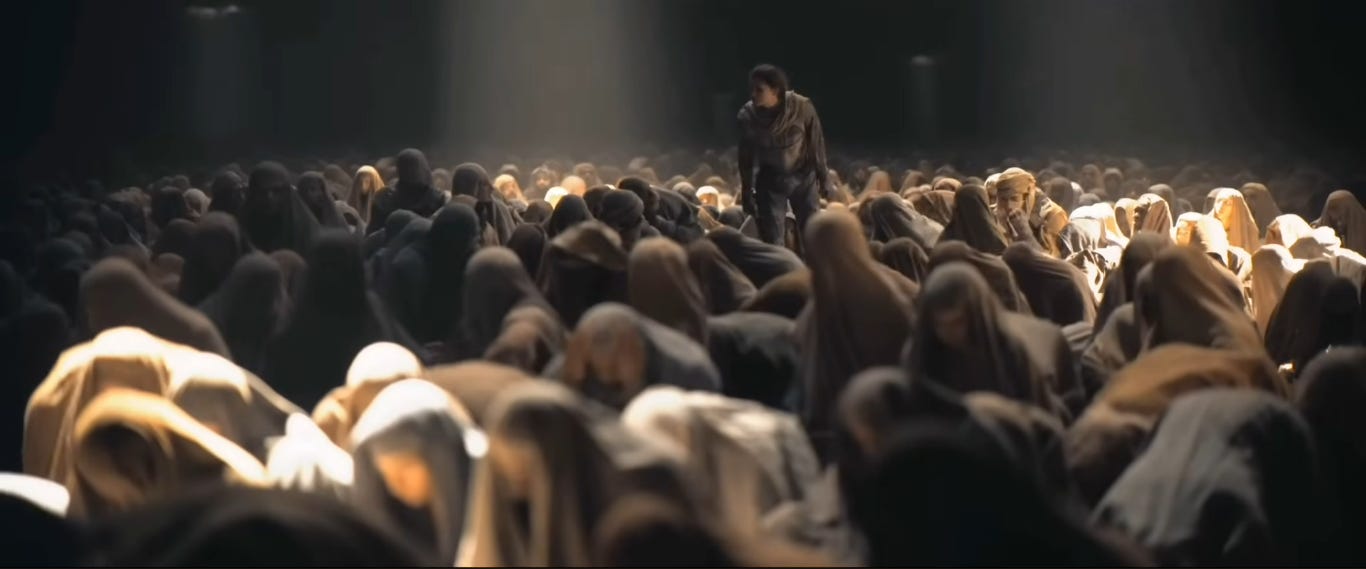
The topic of Chani's radical rewriting is too big to get into here, but is worth mentioning because it helps to show a wider issue that the adaptation suffers from - Leto is an enlightened modern dad, at the expense of setting and consistency; Paul is an aimless, uncommitted rich kid who lacks a sense of urgency until faced by immediate crisis; Chani is an outspoken humanities student who often seems to be the voice of the director, didactically telling the Fremen (and by proxy, us) what message we are supposed to take from the film.
Overall, the trend of the adaptation is to try to make the characters come across as modern and relatable, which does not seem like a great approach when so much of the source material's appeal lies in the way it depicts a society that is alien to us in the same way that the ancient world is alien to us. Perhaps Villeneuve's approach is a great strategy for making a successful blockbuster with broad appeal, but it's not such a great strategy for faithfully adapting Dune, a weird, ambitious, quasi-historical novel rejected by thirty publishers.
Countering the Sardaukar: Leto's cunning
Returning to the book, and to Leto's first conversation with Paul, we also see here another element that does not fully come across in the film - Leto's foresight and his genius as a strategist (Paul is said to inherit his Mentat potential from his paternal line, which checks out). As Leto describes the Fremen to Paul, it is clear that even before setting foot on Arrakis, he has already perceived the Fremen's nigh unlimited potential as a military resource for House Atreides.
He is also aware of the truth about the Sardaukar, the Emperor's elite soldiers, and he explains that what makes the Sardaukar so dangerous is their environment, as their home planet (reputedly the Emperor's prison planet) is so hostile - only the strong survive, and the survivors are bound together by their shared hardships and way of life, as well as a common religion, according to the appendices. The same principle applies to the Fremen, and so they are an ideal counter to the Sardaukar. Leto says that to survive, the Atreides must cultivate 'desert power', a line that is used in the film, and film Leto does indeed deal skilfully with the Fremen, winning their trust with tact and keen awareness - it is Leto's insight that avoids disaster when Stilgar spits on the table in front of him, a sign of respect in Fremen culture that is taken as a deadly insult by the Duke's retainers.
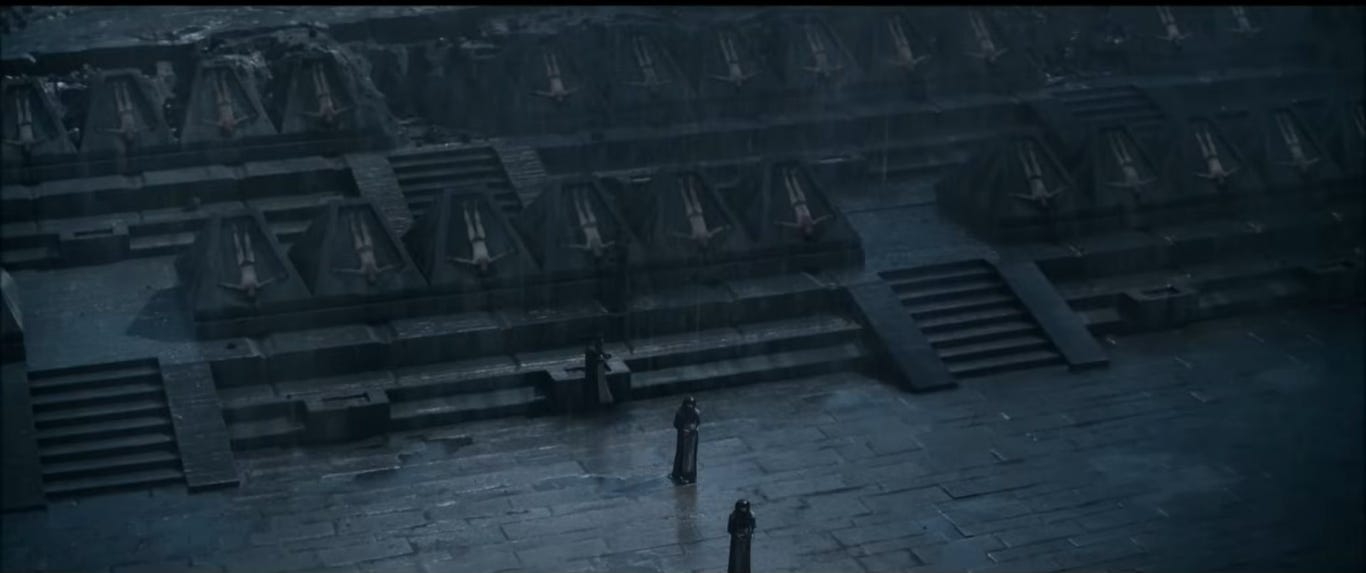
What is lacking in the film is the story of the Sardaukar, and Leto's cold cunning in recognising and mimicking the Emperor's strategy. While the film's Sardaukar are admittedly very cool and menacing, and a source of many memes, we don't learn much about their backstory or parallels with the Fremen (although what we do see is pleasingly consistent with Herbert's description). In the book, meanwhile, the Fremen-Sardaukar rivalry is a constant refrain. There is a kind of magnetism between these two races of elite warriors, to such an extent that after the Harkonnen coup the Emperor's Sardaukar stick around on Arrakis for some time (against orders and against good judgement) to fight the Fremen, because it has been so long since they have faced an enemy that seriously challenges them, and they relish the chance for glory (Astartes-type behaviour, honestly).
'Death thoughts' and the Old Duke
Leto's foresight is also shown elsewhere in the book: he knows who his enemies are, because he knows who has been stockpiling spice in expectation of a coup on Arrakis; he is constantly haunted by 'death thoughts', knowing that his own chance of survival is slim, and plans accordingly; he takes further steps to prepare his son, arranging for Paul to undergo guerilla training; he confides in Paul about his deception of Jessica, so that Paul can tell her the truth if/when his father is killed.
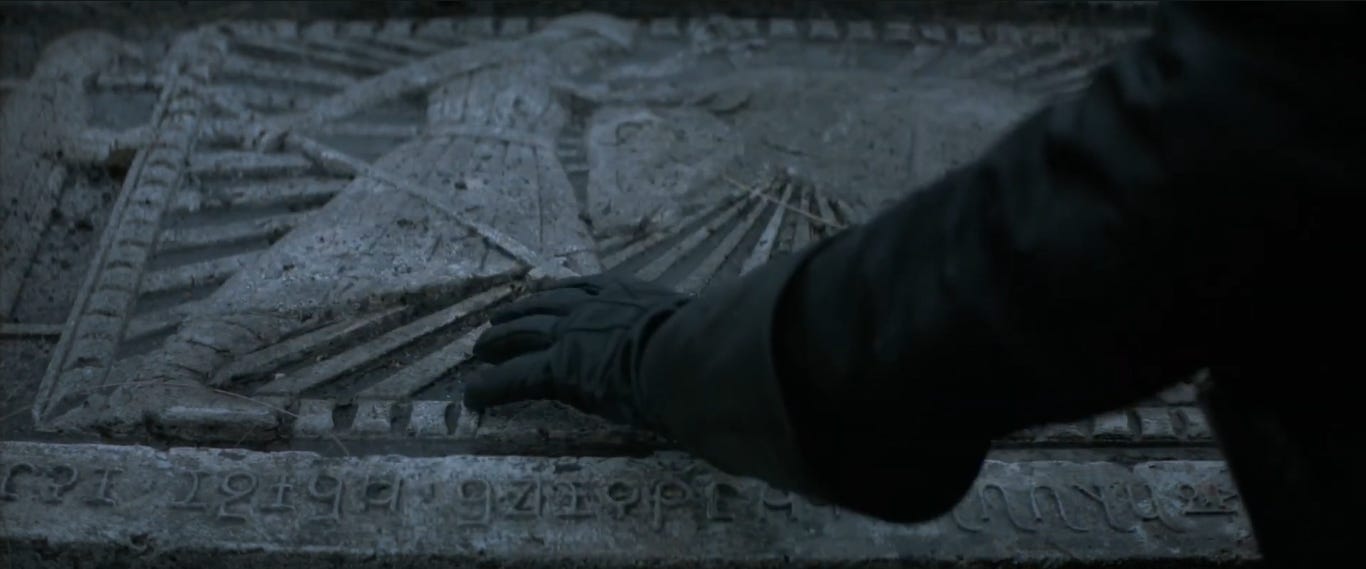
An important piece of symbolism in the book is the imagery of the bull and the matador - this relates to the story of Leto's father, the 'Old Duke', who would face bulls in the arena for the entertainment of his people, and died after being gored. The Old Duke, in a final display of 'bravura', had the head of the bull that killed him preserved, complete with his blood on its horns, and the bull's head hangs opposite the duke's portrait in the dining room. Jessica hates these gruesome ornaments, and especially the portrait of the Old Duke, who she appears to resent. We can infer that this is because, in the spirit of Dune's deterministic philosophy, Leto is predestined by his father's example and ethos to die in much the same way, with Arrakis as the arena and the Baron as the bull.
This is actually another element that the film does subtly and well - early in Part 1, Leto visits his father's grave, which has a relief of a warrior fighting a bull, and Paul speaks of his grandfather's bullfighting. From very early on, we have the impression that Leto is thinking about his own death, and is all too aware that he is following in his father's footsteps by accepting the Emperor's command and taking Arrakis as his new fief.
Leto's dreams for his son
Another epigram is also worth quoting here:
'It is said that the Duke Leto blinded himself to the perils of Arrakis, that he walked heedlessly into the pit. Would it not be more likely to suggest he had lived so long in the presence of extreme danger he misjudged a change in its intensity? Or is it possible he deliberately sacrificed himself that his son might find a better life? All evidence indicates the Duke was a man not easily hoodwinked.'
This epigram suggests an in-universe uncertainty about whether or not Leto knew of his fate, yet from his PoV chapters in the book it's overwhelmingly clear that Leto anticipates his death. But what is meant by Leto's desire for his son to have 'a better life' (also alluded to in the earlier epigram)? This is somewhat ambiguous, but seems to relate to two possible futures Leto foresees for his son (Paul ends up fulfilling both): Paul deposing and succeeding the Emperor; and/or Paul finding a new way of life outside the faufreluches (the Imperial class system) among the Fremen.
The Emperor's rival
To elaborate on the first possibility, it's necessary to discuss another element that is somewhat different (though not necessarily worse) in the film: the relationship between Leto and the Emperor. The Emperor is Leto's cousin but also his bitter rival, who uses the Harkonnens as a weapon against him. In Part 1, we do get some exposition regarding the causes of the Emperor's hostility - Leto explains that the Atreides are seen as a threat to the Emperor because the other Houses look to them for leadership, and the Baron tells Rabban much the same. Irulan's comments contain similar observations, describing her father as a cold man driven by 'the calculus of power'.
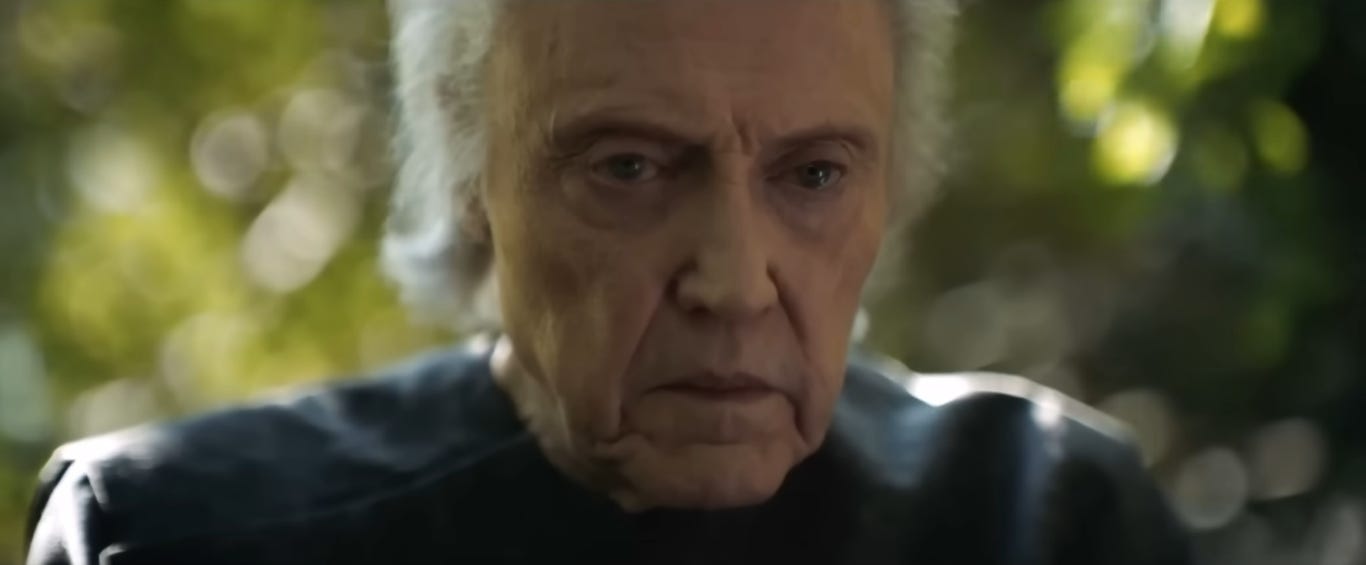
However, the film's framing (and the casting of the ever sinister Christopher Walken as the Emperor) suggests that the Atreides are loyal subjects who become victims of the Emperor's fear and suspicion. In the book, this is not so clear. As discussed above, book Leto is an intelligent, calculating and formidable leader, and would make an extremely dangerous enemy. Bearing that in mind, there is a definite possibility that he really was poised to overthrow his Emperor before being outmaneouvred and forced onto Arrakis. Such a coup would have been legitimised by Leto's blood relationship with the Emperor, who is said to closely resemble him, and by the Emperor's lack of a male heir, which results from an agreement with the Bene Gesserit. Irulan considers that no ruler ever suffered such a total defeat as this agreement imposed on the Emperor (obviously, the Imperium is not very feminist).
Leto and the class system
So, why doesn't the Emperor just adopt Leto as his heir, fixing his dynastic problem and resolving the rift between them? This question is never posed in the book, yet there are definite hints as to the answer - it seems that Leto and the Emperor were ideologically incompatible. The film definitely alludes to this, but the book shows us Leto's ideals in much greater detail. Throughout his chapters, we learn that Leto is deeply disillusioned with the rigid Imperial class system. At one point, he wishes he could abolish class and 'end all social distinctions'; elsewhere, he is weary and exhausted by the constant pressure he feels to project an artificial image of confidence for the sake of his subordinates. He admires Gurney Halleck and the Fremen because he considers both to live outside the bounds of the faufreluches, and is disgusted by the Emperor's bigoted references to the natives of Arrakis as uncivilised barbarians.
Leto also shows his humane nature when he clashes with a household servant over an unpleasant custom in which dinner guests spill water on the floor, which is then soaked up with towels to be wrung out for beggars outside the palace - Leto considers this custom a 'degradation of the spirit' typical of a Harkonnen fief.
Leto's dissatisfaction with Imperial society even extends to his own House's activities. He considers the specialised language describing different types of poison, and the universal use of 'snooper' devices to detect poison, to be an indictment on Imperial society. Later, Jessica marvels at how absolute social trust is among the Fremen; she accepts a drink passed to her by an anonymous hand behind the curtain to her room, and enjoys it without fear of poison.
Elsewhere, Leto bitterly comments on the activities of his own propaganda corps:
'The people must know how well I govern them. How would they know if we didn't tell them?'
The implication is that Leto understands that the Atreides are still an unwelcome, imperialistic force on Arrakis, and for all their good qualities they remain part of the same system as the Harkonnens - the book suggests that its conflicts are not just between individuals or families, but are the result of systematic evils and injustices. Leto’s comment also hints at the moral ambiguity of the Atreides, who often appear to be the good guys, but anyone looks good compared to the Harkonnens, and further cements his desire for change .
Closing thoughts
The question is, how far was Leto prepared to go to bring about this change? Was he truly an innocent victim of the Emperor's paranoia, or were his enemy's suspicions well-founded? The book offers no definitive answer, and so Leto remains an ambiguous figure, per his introductory epigram, and a rich subject of conjecture. Still, his concern with the royal image of his descendants, his discontent with the Emperor's rule, his decision to remain unmarried while the Emperor's daughter is also unmarried, and the great lengths that he has gone to to prepare his son, all hint at a definite possibility that Leto was preparing to supplant his cousin.
To conclude, the literary version of Leto is a substantially more complex and fully realised character. In the book, we learn a great deal more about Leto's values, his cunning nature, and his impact on the world around him, not least his son. Sadly, it seems there simply isn't space in the film to develop him; much is omitted, and efforts to characterise him more efficiently (e.g. his 'gentle parenting' scene with Paul) sacrifice important worldbuilding in the name of pacing and relatability.
Most of this was, perhaps, inevitable - a complete and faithful adaptation of Dune might be technically possible, but it surely wouldn't be profitable. Perhaps it would be better suited to TV, but in the age of Netflix's Witcher, House of the Dragon, and The Rings of Power, I would honestly rather wait 40 years for another competent director to try their hand at Dune. Considering the complexity and sheer uniqueness of the source material, it's not hard to see why so many decades have passed since Lynch's effort, despite the novel's reputation as the grandfather of epic sci-fi.