

Event Horizon: Is It Actually Good?
One of the films of all time

Introduction
Event Horizon is a sci-fi horror shitpost from 1997 that has managed to become a cult classic despite its commercial failure and dubious quality. The director was Paul Anderson, who is not on many cinephiles’ radar. Statistically, you have probably never seen any of his films, though they are legion, and they’re tied to impressive names and big franchises - Anderson is, among other things, a prolific maker of video game movies, such as Mortal Combat (1995), Monster Hunter (2020), and a slew of Resident Evil movies through the 2000s and 2010s.
The latter mostly did well at the box office, which might explain why they keep letting the man work in Hollywood - most of his films lose money, sometimes enormous amounts of it. His most recent, Lost Lands (from this February) cost $55 million, and barely scraped $6 million back at the box office.1 They don’t do well critically either - even his profitable Resident Evil films have miserable ratings on Rotten Tomatoes; the ‘best’ has 36% approval, the lowest 18%, which you’d be hard-pressed to beat. Other than the RE films, his best known would probably be Alien vs Predator (2004), which also made money but has a woeful reputation,2 and is for the most part resolutely ignored by fans of Alien and fans of Predator.
Event Horizon, despite its popularity in certain niches of the nerd ecosystem, pretty much fits into the Anderson paradigm - it cost $60 million to make, made $42 million back, and holds a 36% approval rating on RT. However, it is distinguished by a few things: a) it’s an original screenplay, not a franchise piece; b) it has a bafflingly impressive cast, featuring Sam Neill, Laurence Fishburne, and Jason Isaacs; and c) it has experienced a gradual critical re-assessment. Rob Ager considers it to be not terrible, and various others have noted its seminal relationship with other media, such as the later Dead Space video games,3 as well as its relationship with Warhammer 40,000, which the screenwriter (Philip Eisner) acknowledged as an influence. There’s also likely a relationship with Disney’s The Black Hole, which likewise featured a lost spaceship, a mad scientist, and wormholes leading directly to hell.
Event Horizon is also gruesome, nasty, and really quite scary when it wants to be. There are, of course, definite problems: I don’t think critics were necessarily wrong about it in the first instance, but there is an extent to which this could be described as a good bad movie, if not a good movie.
Synopsis
Before going further, a plot outline:
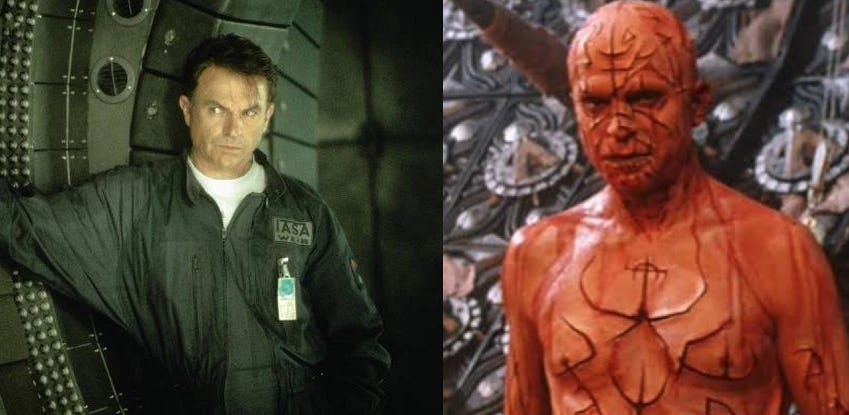
Event Horizon takes place in a gritty near-future4 in which humans are exploring the solar system. The plot revolves around the titular Event Horizon, a lost exploration craft fitted with an experimental engine allowing it to travel faster than light. This device was developed by Billy Weir (Sam Neill), a brilliant but arrogant scientist who we are about to watch spiral into depravity. His arc is essentially to become a Cenobite from Hellraiser. He also has a dead wife, whose fate we’ll be learning about shortly.

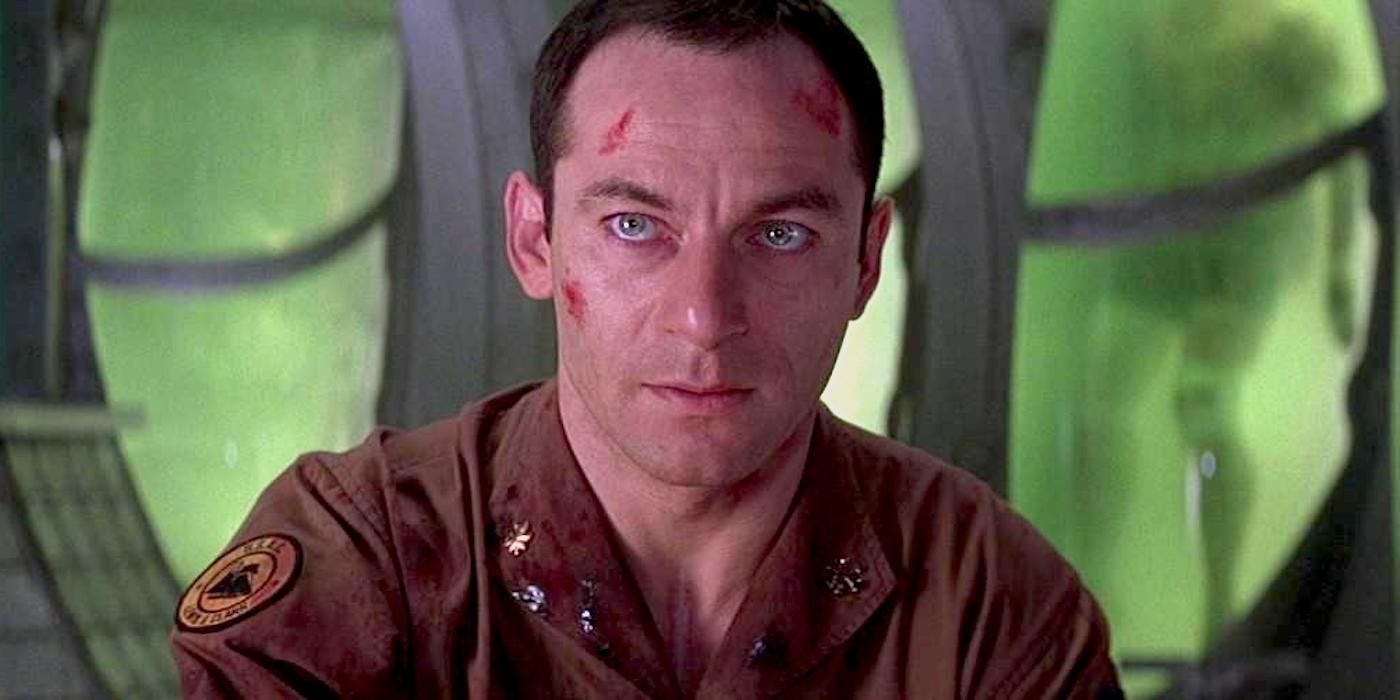
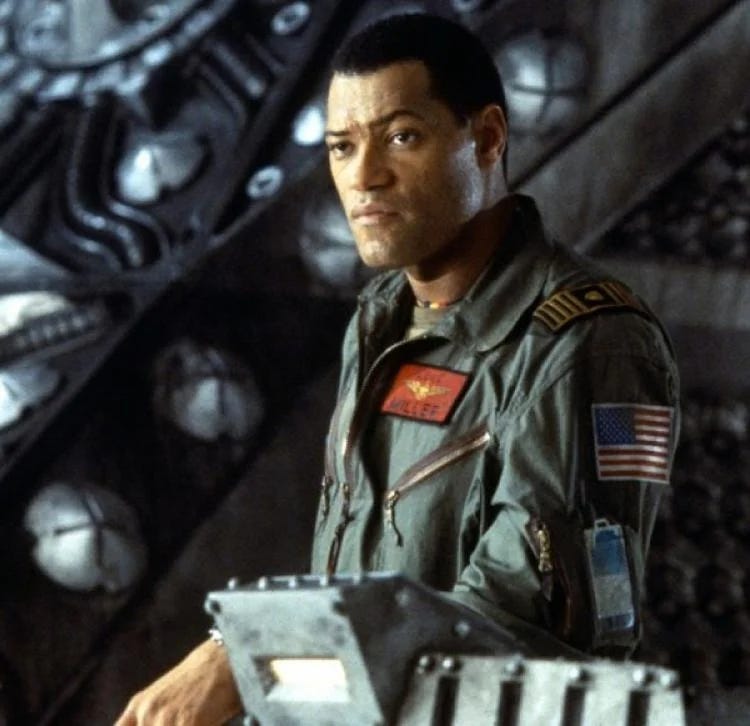
How it started/How it’s going. Weir is sent on an expedition aboard the Lewis and Clark to find the Event Horizon. The L&C seems to be technically a government ship, but the vibe is Alien-esque, i.e. they seem like a bunch of randy space truckers. Cooper, the rescue technician, introduces himself to the audience with the most cackle-inducing line, offering a woman coffee with the words ‘Would you like something hot and black inside you?’, which kind of sets the tone. The most important introduction is to the stern Captain Miller, played by Laurence Fishburne, who is chilly towards Weir, disliking the presence of a civilian on his mission. We also meet Jason Isaacs’ character, the medical doctor, known as D.J., who says that his full name is D.J. Trauma. Everyone laughs when he says this, except D.J., so we can only assume it is his actual name, and he has been resisting his true calling of working at some kind of niche gay bar.
D.J. explains the contents of the Event Horizon’s distress signal, which is garbled apart from the Latin words ‘Liberate me,’ meaning ‘Save me.’ No-one is as creeped out by this as they should be.
Weir explains the workings of the Event Horizon’s experimental engine to the crew, in the most cliched movie exposition scene I’ve ever beheld. We’re talking ‘in English, Einstein,’ poking holes in bits of paper with pencils, unnecessary technobabble, etc. etc. Apparently, they duplicated this scene for Interstellar. The gist is that the EH works by making a wormhole and travelling through it to reach distant parts of space. There’s also some character work here, as Weir antagonises the pilot, Smith - a man who, in the idiom of Alien, brings vast quantities of old-school pornography into space with him - by unnecessarily poking holes in a favourite pin-up poster, symbolically cucking him.5 Weir maintains a supercillious tone throughout, aided by Sam Neill’s stab at an English accent, which results in more of a mid-Atlantic drawl. These two will later nearly come to blows, and the whole conflict is fairly class-coded.
When asked where the ship goes between point A and point B, Weir replies that no-one knows. Ominous at best.
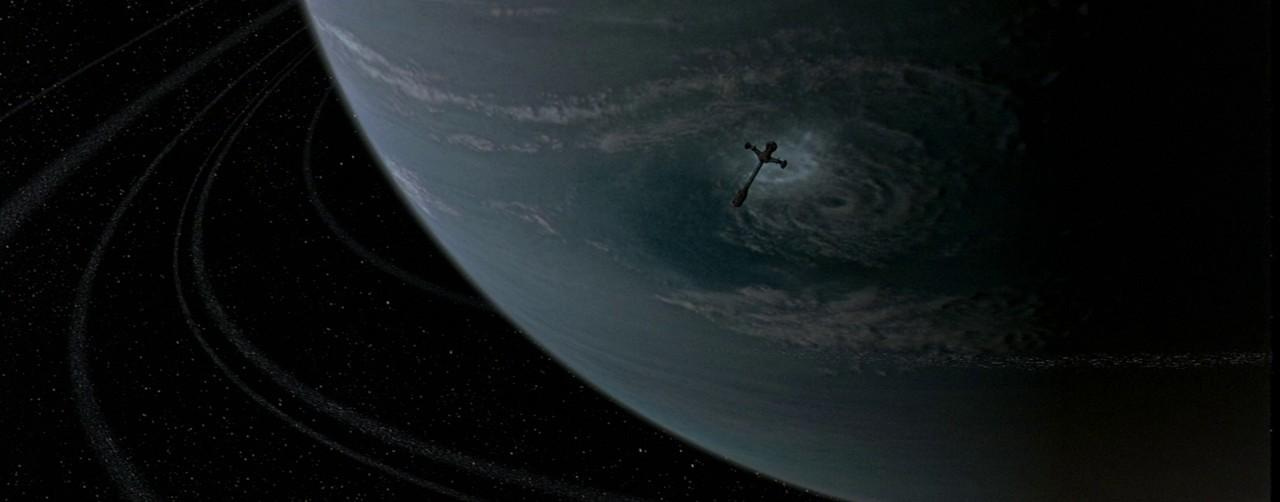
The L&C arrives at Neptune, where the ruins of the EH are in orbit. The ship has a long skeletal mid-section which we’re told can be severed in an emergency, allowing the front part of the ship to function as a lifeboat. A boarding is made, and the vibes are truly rancid. It’s a dark, deserted haunted house with mysterious fleshy growths on the walls that are alluded to but never directly addressed. Peters, the medical technician, discovers an eyeless frozen corpse floating in zero gravity on the bridge.

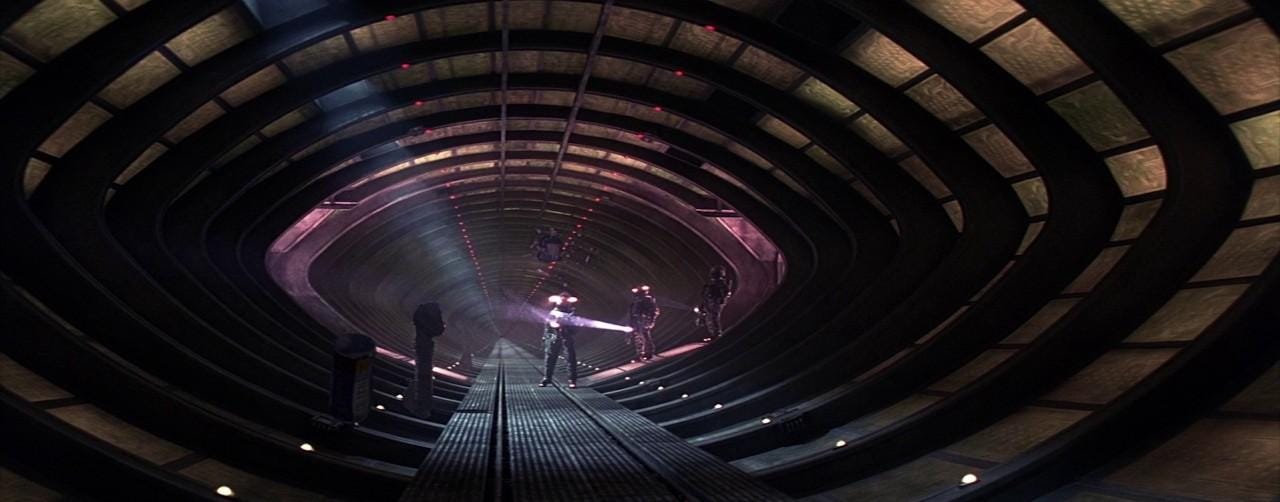
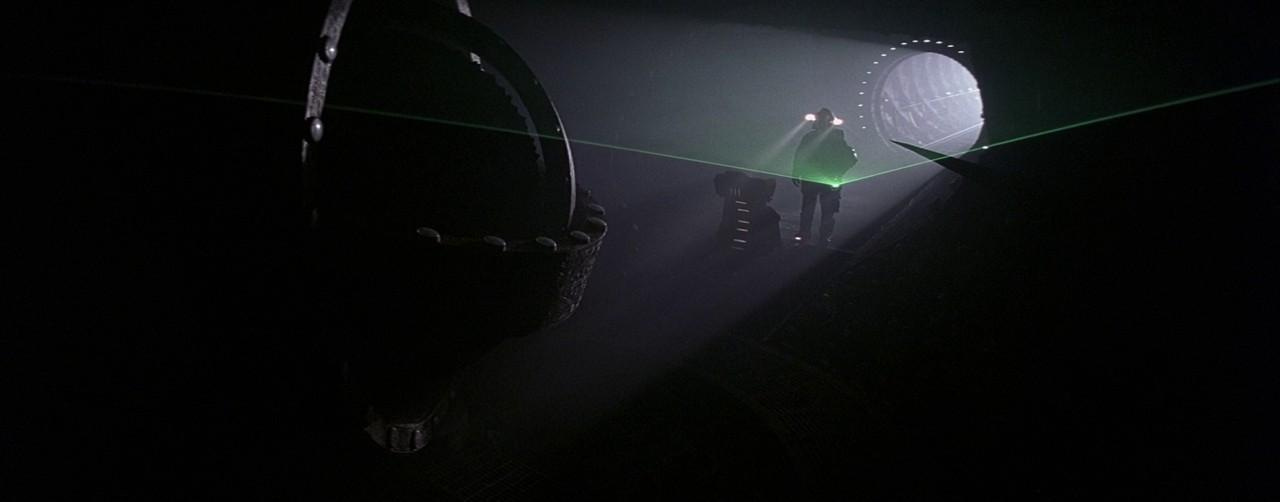
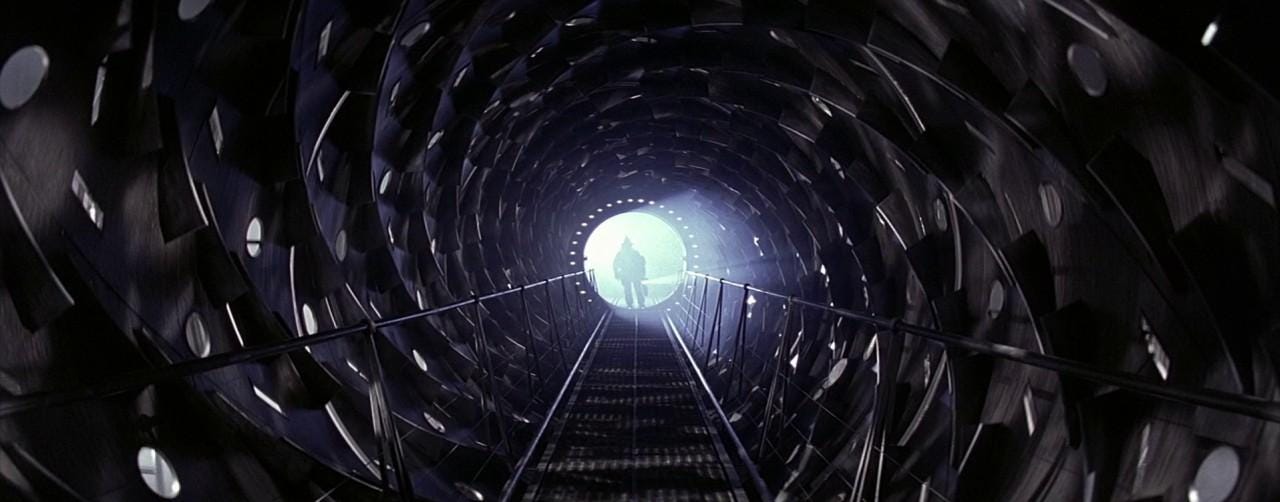
The eye-shaped hallways are surely linked to the eye-gouging, and we see a lot of eye motifs in the architecture. This motif is connected to the black holes, and to the unseen demonic presence watching the characters. Meanwhile, Ensign Justin approaches the ship’s wormhole-generating engine core. This is probably the film’s best-known and most iconic image, with an ominous, angular tunnel lined with spikes leading towards the core, a complicated spherical device with various rotating sections connected together like an astrolabe. There’s a touch of black magic to the design, and a hint of old nautical tradition. As Justin approaches, the engine turns on spontaneously and the core shapes itself into a kind of black portal, into which he is drawn. He is soon ejected, and a shockwave rushes through the ship, damaging the L&C and hindering escape.
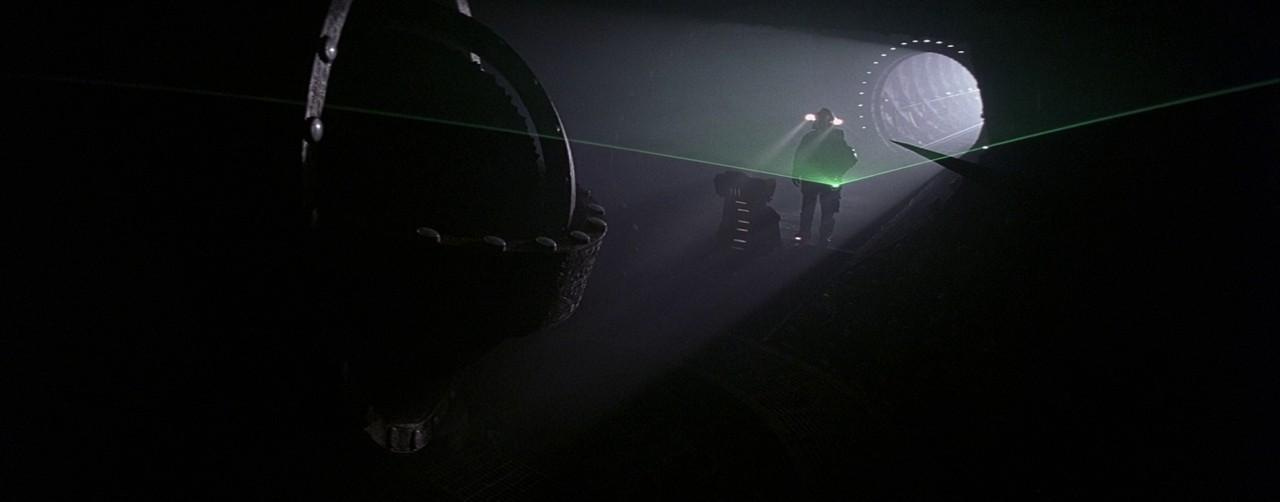
Justin approaches the engine core. Note the round door behind, playing into the eye motif. As the crew is trapped aboard the gloomy, claustrophobic Event Horizon, things get even creepier. Weir keeps hearing his dead wife calling him to join her; Miller sees a crewman he failed to save in the past; Peters sees her young son with his legs covered in gangrenous wounds; Justin swings between catatonia and possible demonic possession. He sleep-walks into an airlock and attempts to vent himself into space, and in a cruel twist he becomes lucid and terrified once the countdown is engaged. Miller is able to save him, leaping in a space-suit from outside the ship to force him back into the airlock, though he is left horribly wounded by the ordeal.6
Miller wants to abandon and destroy the Event Horizon, as there is no-one left to save; Weir, however, is clearly a bit too invested in it, for reasons that will soon become clear, and refuses to leave. Weir also provokes Smith by dismissing his concerns as ignorance, and D.J. breaks up the fight by threatening Smith with a scalpel.
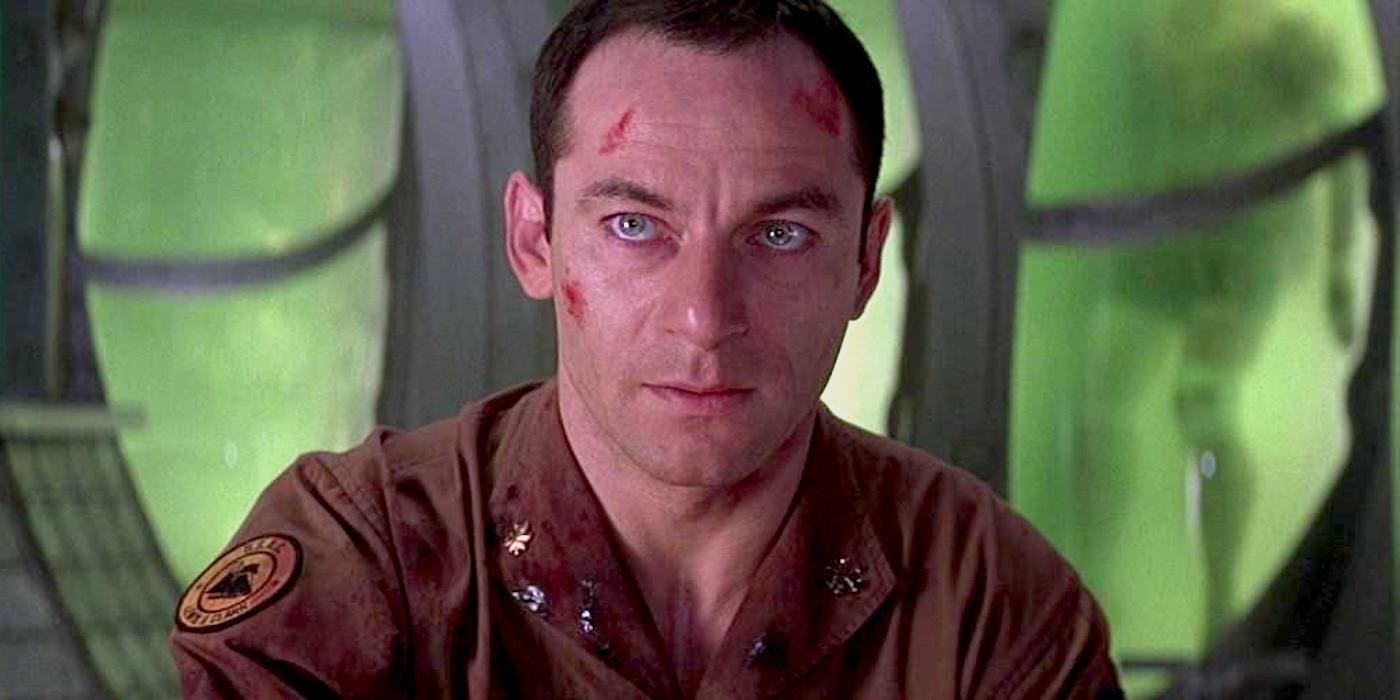
D.J. has an edgy, coked-up kind of energy. D.J. takes Miller aside and explains that the distress call was mistranslated - the actual Latin phrase was "Libera te tutemet ex inferis", i.e. ‘save yourself from hell.’ He concludes (reasonably, in the circumstances) that the ship’s drive brought something evil back with it from the unknown place beyond the wormhole, and that it’s still aboard.
This is confirmed when the crew discovers a truly hideous snuff film of the possessed crew eating each other alive, while the captain chants in Latin and holds his own eyeballs in his hands. There’s a moment of (possibly unintentional) humour as the feed cuts off, leaving crew and audience traumatised, and without missing a beat Miller flatly declares ‘We’re leaving.’ He’s an almost comically sensible horror protagonist.
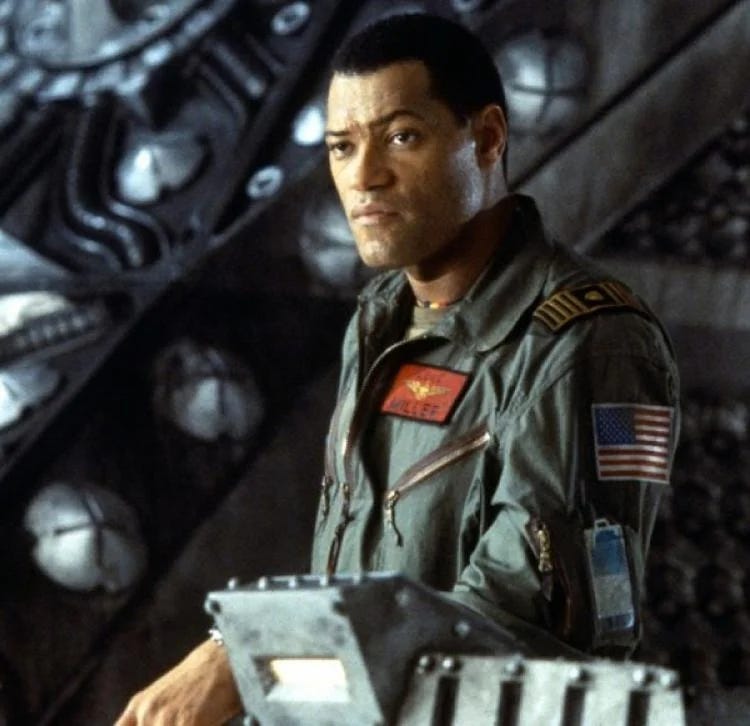
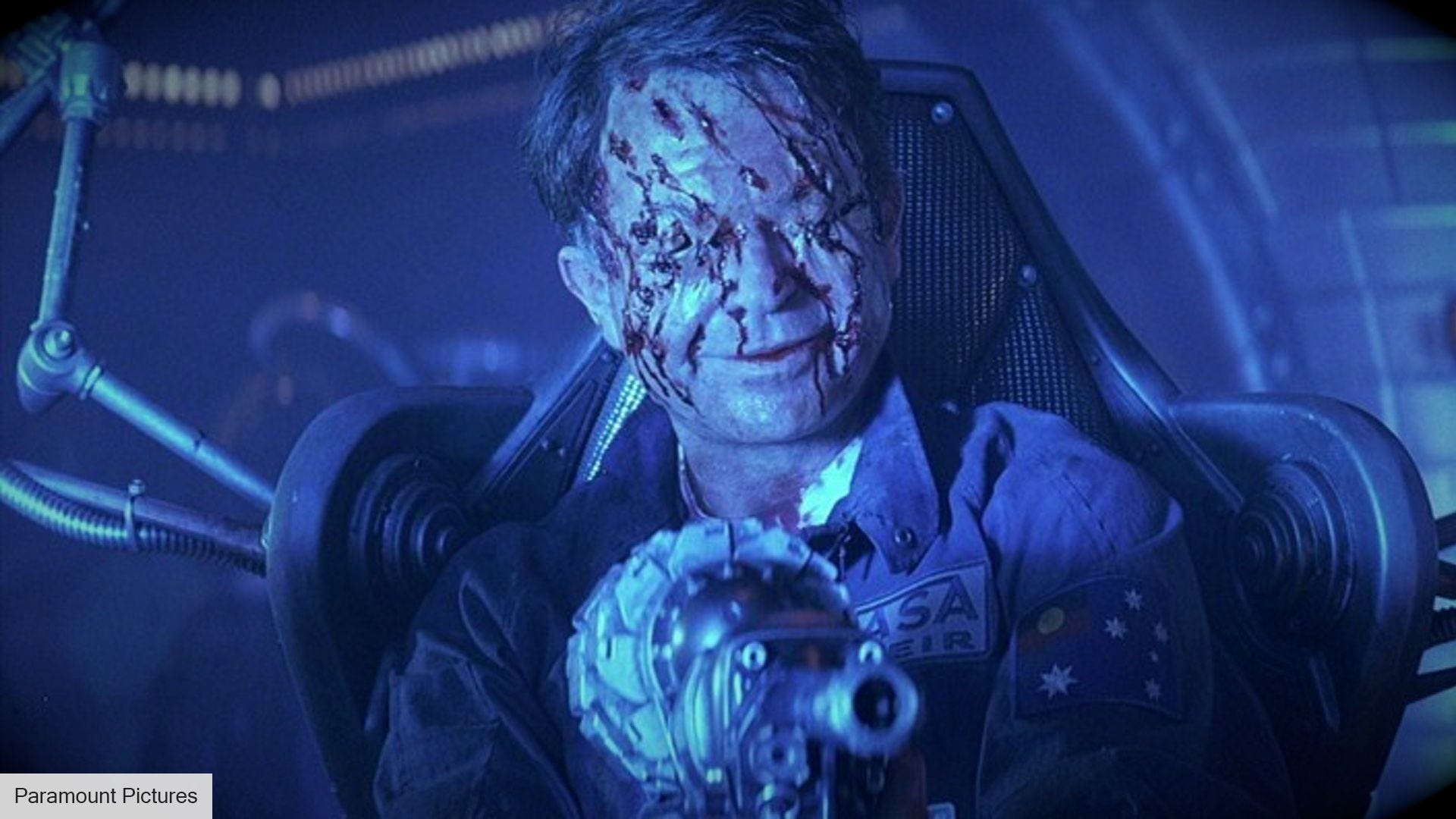
We like Miller. Unfortunately, while all of this is going on, Weir is nowhere to be found, and is already busy gouging his eyes out and succumbing to the darkness. Amidst all this, we see a flashback of his wife’s suicide, for which he blames himself because of his absence and his obsessive devotion to his work.7 He proceeds to go on a killing spree, blowing up the L&C with the pilot on board, vivisecting D.J. and hanging up his corpse (a cruelly ironic fate for a doctor), and starting the engine to return the ship to the other side of the wormhole, which Weir simply calls ‘Hell.’
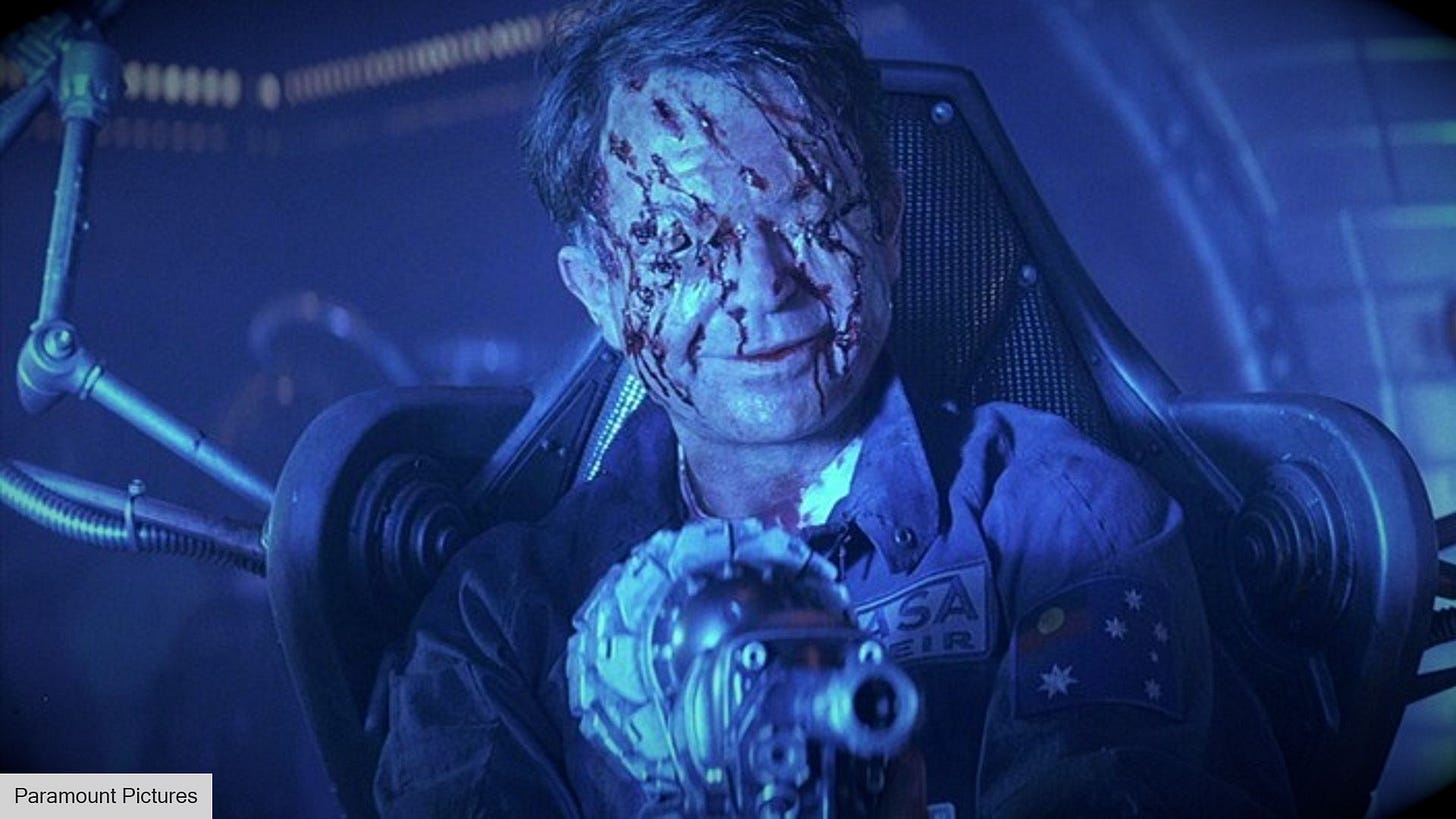
Weir post-gouging. In the final sequence of the film, Miller confronts Weir on the bridge and then later in the engine room, where he also meets the fiery ‘ghost’ of his former lost crewman. In his last appearance, Weir has eyes again, but is bald and has gory ritual markings carved into his skin. Miller is repeatedly shown visions of hell, conveyed very effectively by rapid frames of hideous images of torture and mutilation. Although Miller succeeds in severing the ship’s mid-section, allowing his surviving crew to escape in the lifeboat section, the rest of the ship falls into a vortex, implying that Miller may be doomed to hell.
The final scene is ambiguous, and shows the survivors woken from stasis by a rescue team. Starck, one of the crew, has a vision of the scarred Weir in place of the rescue worker, and as the camera pans out from the screaming Starck, the door closes ominously.
Assessment
Event Horizon is kind of a difficult film to write anything analytical about, because it is pretty much entirely surface level, and everything a Robert Eggers or Ari Aster might expect you to puzzle out for yourself is stated directly. A central theme is obviously trauma,8 alluded to by the doctor’s (ludicrous) name, by Starck’s state at the end, and by the three key stories of Miller, Weir and Peters, all of whom are defined by traumatic past events, which make them vulnerable to the machinations of the EH’s unseen presence.
Miller’s story is simple but it’s not terrible, in no small part because he’s being played by Laurence Fishburne, who brings presence and dignity to the role. He also gets some of the better dialogue, notably a vivid description of fire in zero gravity moving beautifully like a liquid as it consumed the crewman he couldn’t save. He speaks about knowing that he did the right thing, and that there was nothing that he could have done, and yet he is still unable to accept it and move on.
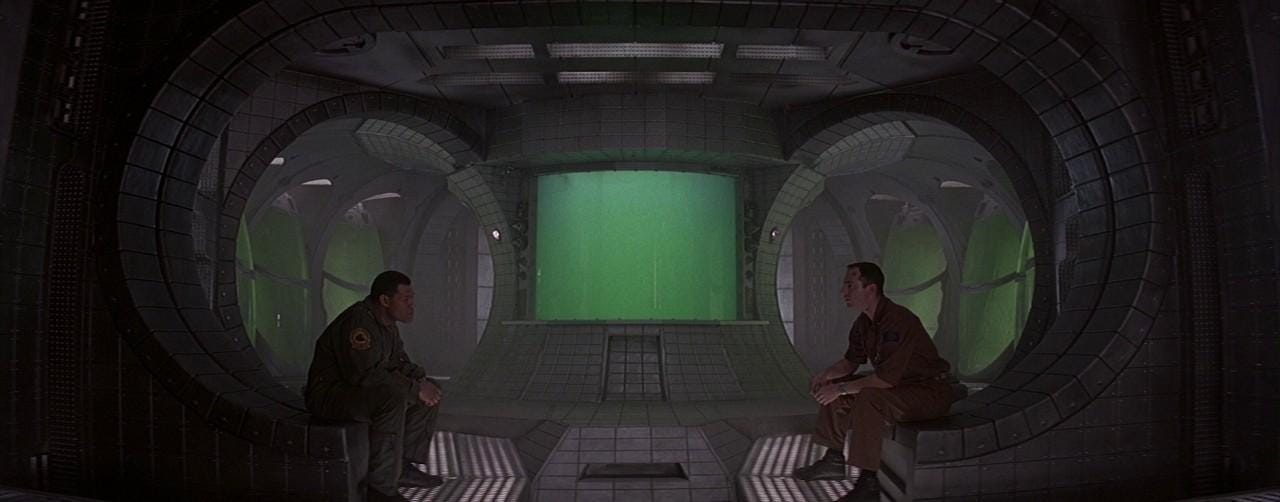
This pays off nicely in a scene when he is faced with a similar choice, and takes a moral action instead of a rational one; he doubles down on this again later, deceiving his crew so that he can seal them aboard the lifeboat and sacrifice himself for their sake. The subsequent sequence with the burning ghost is perhaps a bit too baroque and heavy-handed, given the implications of these earlier moments, and distracts from the menace of Weir.
Weir also stands out as one of the better characters, a) because he’s being played by Sam Neill, and b) because he’s batshit insane. The film does quite a good job of presenting him initially as the protagonist, only for it to gradually become clear that he is actually the villain. His superior attitude to the crew at the opening hints at his darker side, which is only fed by the evil presence aboard the Event Horizon. He’s arrogant, snide and obsessive, but not without a certain brazen charm.
Peters, played by the lesser-known Kathleen Quinlan, is a more minor role but a respectable one. Again, there’s very little subtext: the story is that she is separated from her husband and is evidently kept from her son by her work, who she bitterly misses and worries about. It is this anxiety that the Event Horizon plays on, first with the vision of the boy covered in maggots, and again in the final act, when she ‘sees’ him and hears him calling to her in the engine room: while chasing after this apparition, she falls to her death with a sickening crash. Peters’ fate is nicely foreshadowed during the boarding sequence: when the ship’s artificial gravity is turned on, the frozen corpse of the captain falls and shatters into pieces.
As for the rest of the crew, their characterisation is thinner, and in general there’s a sense that they are just slasher-fodder, there only to make up the numbers. Jason Isaacs is good, unsurprisingly, but his role is fairly limited, and we don’t learn anything about his background, other than that he has a ridiculous name, speaks Latin,9 and is prepared to threaten a colleague with a scalpel at the drop of a hat.
It has to be said that the quality of the script is clumsy throughout, even with the better characters, and full of unnecessary bloat that shouldn’t have passed muster. For example, in Weir’s introductory scene, we’re shown a morbid shrine to his wife: this would be more than enough to indicate that something’s not right with this man, and that it has something to do with a woman in his life (or not in his life). Instead, Weir has the pointless line ‘Claire, I miss you,’ as if the viewer couldn’t have inferred that he missed this woman and she was no longer around. The screenwriter, Philip Eisner, has very few writing credits to his name, and their ratings are abysmal across the board: his Mutant Chronicles (2009) has 17% on RT, while Sweet Girl (2021) has 24%. Event Horizon is actually his highest-rated and best-known work to date, and it wasn’t a successful film.
Presentation
The film also suffers from uneven quality in terms of its production. The gore, a major selling point, is notably well-done, with gruesome practical effects on the level of Hellraiser, and the director excels at showing brief glimpses of horrific imagery to flashbang the audience. It’s notable that, contrary to its original concept,10 this is a monsterless film, with the evil instead acting through human intermediaries, deceptively speaking to the crew with familiar voices to sow corruption.
The interiors of the ship are also respectable: they’re dark, oppressive, and claustrophobic, with a lot of weird-looking angles and surfaces with no obvious function other than to disorient and discomfort the viewer. Again, there’s a touch of black magic in all of this: it does not feel like an ergonomic, futuristic craft, but instead something strange, opaque and secretive. The eye motif is also cleverly worked into the ship’s design many times. Finally, the costume department was on to something, with the crew’s hard-wearing uniforms and restrictive space suits clearly copying Alien’s homework.
In production terms, the film’s greatest sin is the use of truly abysmal late 90s CGI, particularly for exterior shots of the ship, backgrounds, and some early zero-gravity interior shots. It’s jarringly bad, looking PS2-era at best: this was a time when physical models of spacecraft still looked dramatically better than anything a computer could generate. Alien was nearly 20 years old at this point, and still looks far better, though it was made at a fraction of the cost.
Closing thoughts
Is Event Horizon a misunderstood masterpiece? Lmao, no. Is it a work of high art? Not at all. Is it as contemptible as critics considered it at the time? Maybe not. Perhaps this speaks more to the homogenous nature of today’s genre films, rather than the particular virtues of Event Horizon, but the film is, if nothing else, memorable and distinctive, with its own particular look, voice and character. It offers a suitably rancid atmosphere, and some images that will stay with you.
It’s very much pulp entertainment, but pulp is not necessarily a bad thing, and if you’re willing to indulge Event Horizon, you will find resonant themes and ideas: guilt, sacrifice, obsession, ego, regret. Are these the most sophisticated characters? No, but on the other hand, Shakespeare didn’t shy away from stock characters, melodrama and gory gross-outs. Of course, he was a lot better at putting words in the right order than Phillip Eisner is, but you know what I mean.
One wonders if it was advertised at all, and if so, where? They even had Dave Bautista in the lead role, which seems like a waste.
21% on RT. Oof.
Which are literally just Event Horizon but with zombies.
2047
Was going to cut this line but I’m leaving it in because it’s a) funny and b) objectively the correct reading of the scene.
(which involves further eye-based horror, with Justin’s eyes almost popping out under the depressurisation)
(hence his disproportionate investment in the EH)
This can be linked to Solaris (1972), Andrei Tarkovsky’s Soviet space psychodrama, which anticipated Tarkovsky’s later Stalker (1979). I have not seen Solaris, so can’t speak to specifics, though Stalker is largely about a group of men dealing with their catastrophic emotional issues in a dream-like liminal space. It’s wonderful.
Isaacs is playing him with an Irish accent, so perhaps the deep lore is that D.J. Trauma is an Irish Catholic ex-priest. We’ll never know.
It was originally going to be an Alien-like.
Thanks for reading! Yeah, there are about ten minutes of deleted scenes on Youtube, including a few seconds of extra gore, but it's mostly just exposition work.
Event Horizon is a very striking and entertaining movie even if it's not a very good one, but every time a movie feels the need to explain to the audience the concept of wormholes, space-time, time dilation, ect, my eyes roll all the way around in my skull until they're pointing straight into Hell.