

Game Box Extras That Meant Something to Me
A tribute

The news that Playstation is going to stop selling physical games appears to have hit millions of people like a freight train.
Now, maybe the reaction has been more heated than strictly warranted, given the many more pressing worries we all have in the world today. Here on Substack, Jim Mander had some sensible words on the subject, which help to put the change in perspective. He pointed out that such a change would hardly be a first for an industry that, in its early days, used to print hundred-page manuals full of bespoke lore and illustrations, and now manifestly no longer does that. He also alludes to the fact that many of the best new games today are by necessity digital-only already, as they come from the indie side of the industry rather than from the big-money trend-chasers.
As true as this is, I still can’t help but feel the change as a loss - maybe not a huge loss in the grand scheme of things, but a real loss nonetheless. If I were to give a hot take on why it feels that way, I’d suggest that it has something to do with the chronic uncertainty of modern life, particularly for those in the 20 to 40 demographic that make up a majority of gamers. At this point, any change tends to feel like the ground quaking under our feet.
In a way, the fact that games are a pleasure and an indulgence, rather than a strictly defined survival need, makes such a disruption hit harder rather than softening it. For many of us, video games are a necessary refuge, and unilateral, supply-side changes affecting whether and how we can access the games we love are therefore felt especially keenly.
And it must be said that, whatever the reasons, it’s beyond annoying that we’ll likely have to digitally re-purchase games we already bought long ago. All things considered, we’d be wise to hang on to the consoles we have for as long as we can. God knows, RAM ain’t getting any cheaper any time soon.
What I will say, though, is that if nothing else, the news has made me think about the games I value in a different way, and specifically about what it is that makes them so attractive as physical artifacts.
For context, I am (to my mild shame1) the kind of adult who still buys a few action figures a year, and I tend to keep the boxes, not because I’m a ‘brand new in box’ e-commerce grindset person, but simply because I like boxes. I like the colours, the typefaces, the descriptions and the pictures. Most of all, I like the excitement made manifest in a box. A box isn’t just a box - it’s promise and enticement, a touch of magic to take the edge off.
What is true of toy boxes can also be true of game boxes, particularly when we consider the actual contents - not the discs, which are all pretty much just discs, but the printed extras that we often used to happen upon. These became rarer and rarer through the 2010s, and in the 2020s you’re lucky to get a sheet with a code on it, but the fact that extras were non-standard made them all the more exciting.
Something about such extras felt distinctly human - as if a developer somewhere along the line had been thinking of you, the end-user, with something other than the saturnine indifference that many big studios today seem to feel towards anyone who’s not prepared to fork out a hundred US dollars for a game they might not enjoy.
Maps I have loved
Being the age that I am, and the type of person that I am, my early life was pretty much defined by Peter Jackson’s Lord of the Rings trilogy, and the corresponding boom in fantasy novels. Around this time, I owned a tie-in book with a large two-page printed map of Middle Earth, as seen in the movies, which I used to gaze upon while imagining going on quests.
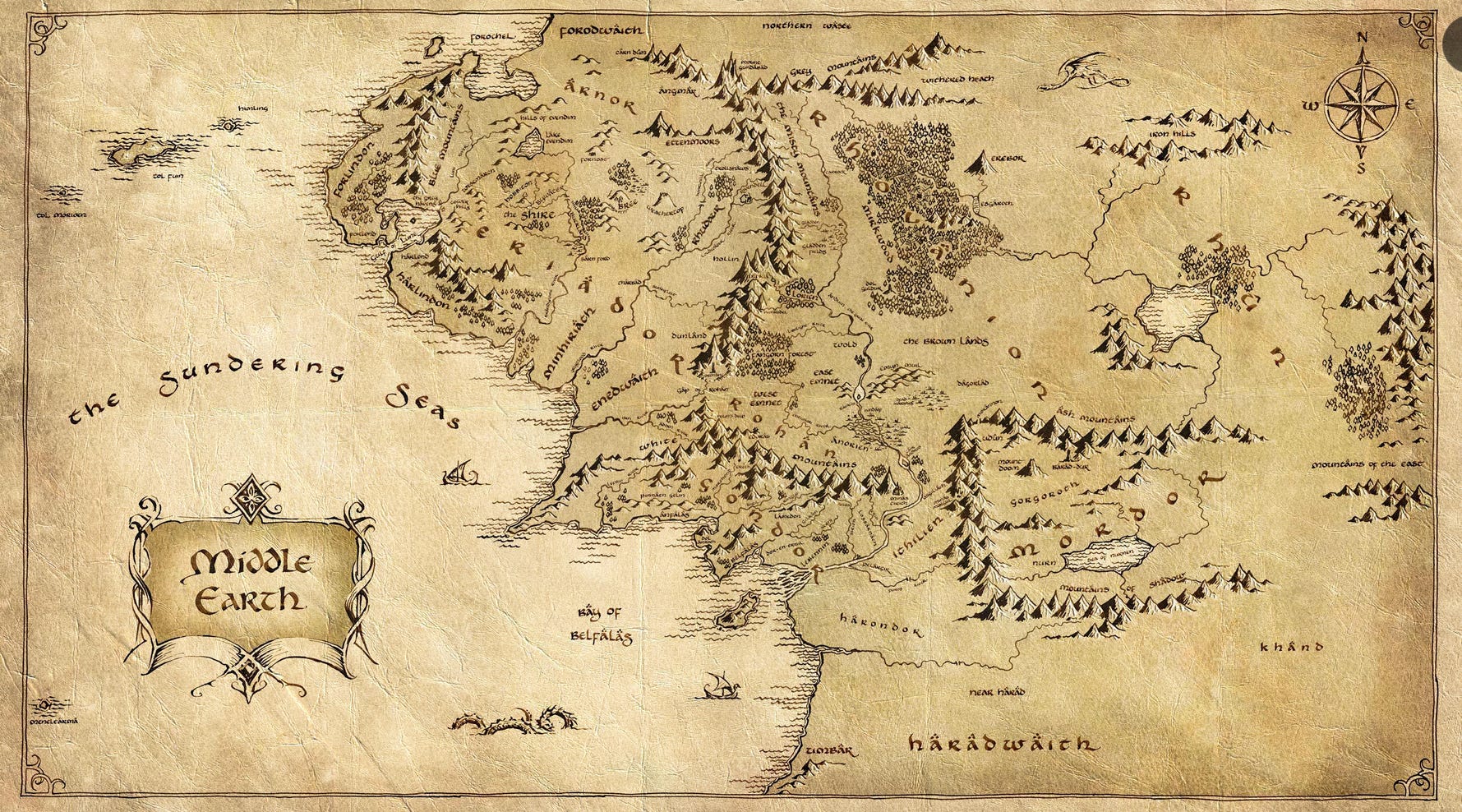
This was, of course, based closely on Tolkien’s own map illustrations. Maps are referenced many times in The Lord of the Rings and particularly The Hobbit, where Bilbo’s fascination with maps is mentioned more than once, and Thorin’s map of the Lonely Mountain, with its secret moon-letter inscription and opaque instructions, is an important plot device.
For decades now, it has been more or less mandatory for a fantasy novel to begin with a map, and it’s also not unheard of for a game box to contain a map of the world we’re about to take our first steps in.
Skyrim and Oblivion
The first game I played with a map in the box was, of course, Skyrim. How could it not be Skyrim?
The game box boasts a glossy printed map, carefully folded to fit. In contrast to the in-game map, which is fully 3D and complete with clouds and effects, the printed map is made up to look like an in-universe artifact, with an aged parchment appearance, a stylised compass showing the cardinal directions, and the name of the cartographer.
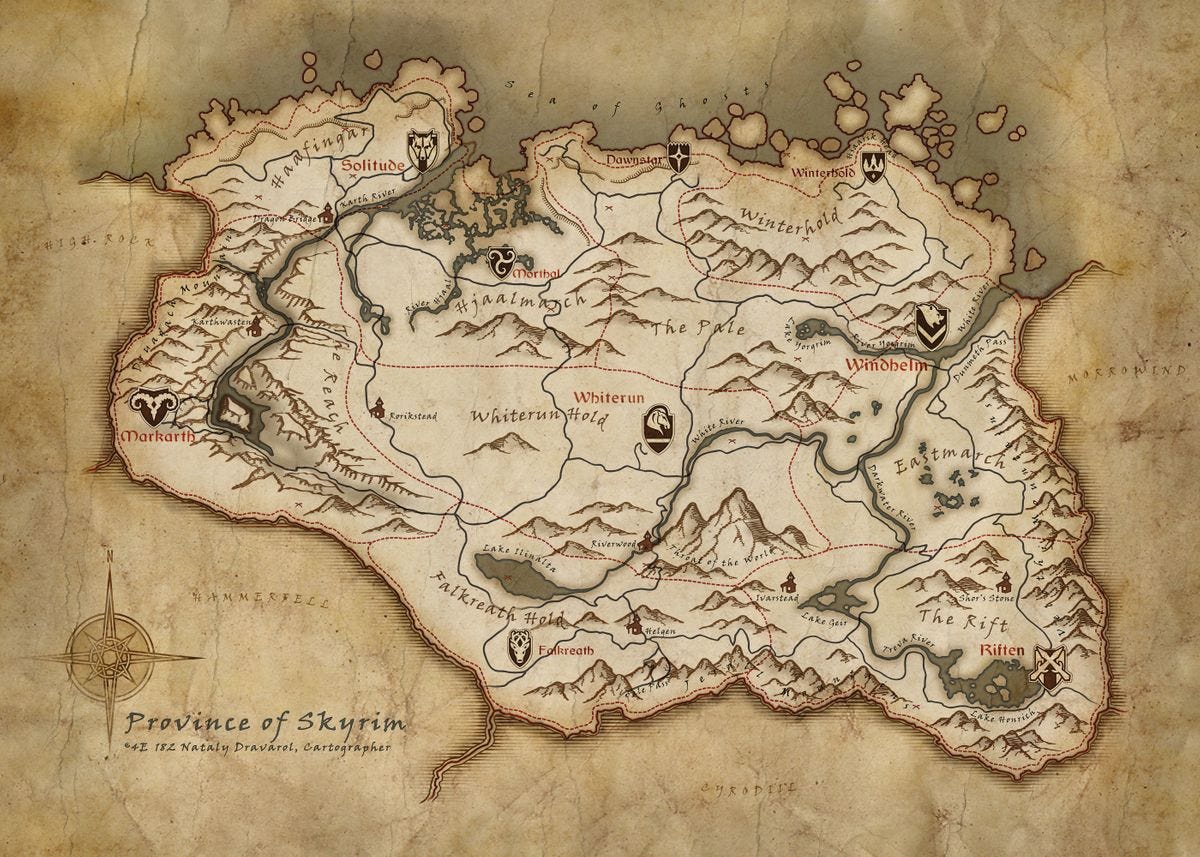
The archaic, yellow-and-brown, hand-drawn style is highly evocative of Jackson’s Middle Earth map, with shaded mountain ranges, dark highways, and dotted red lines describing the borders of each jarldom, and insignias marking the hold capitals. The surrounding provinces aren’t shown in detail, but are each named, putting Skyrim in its proper context.
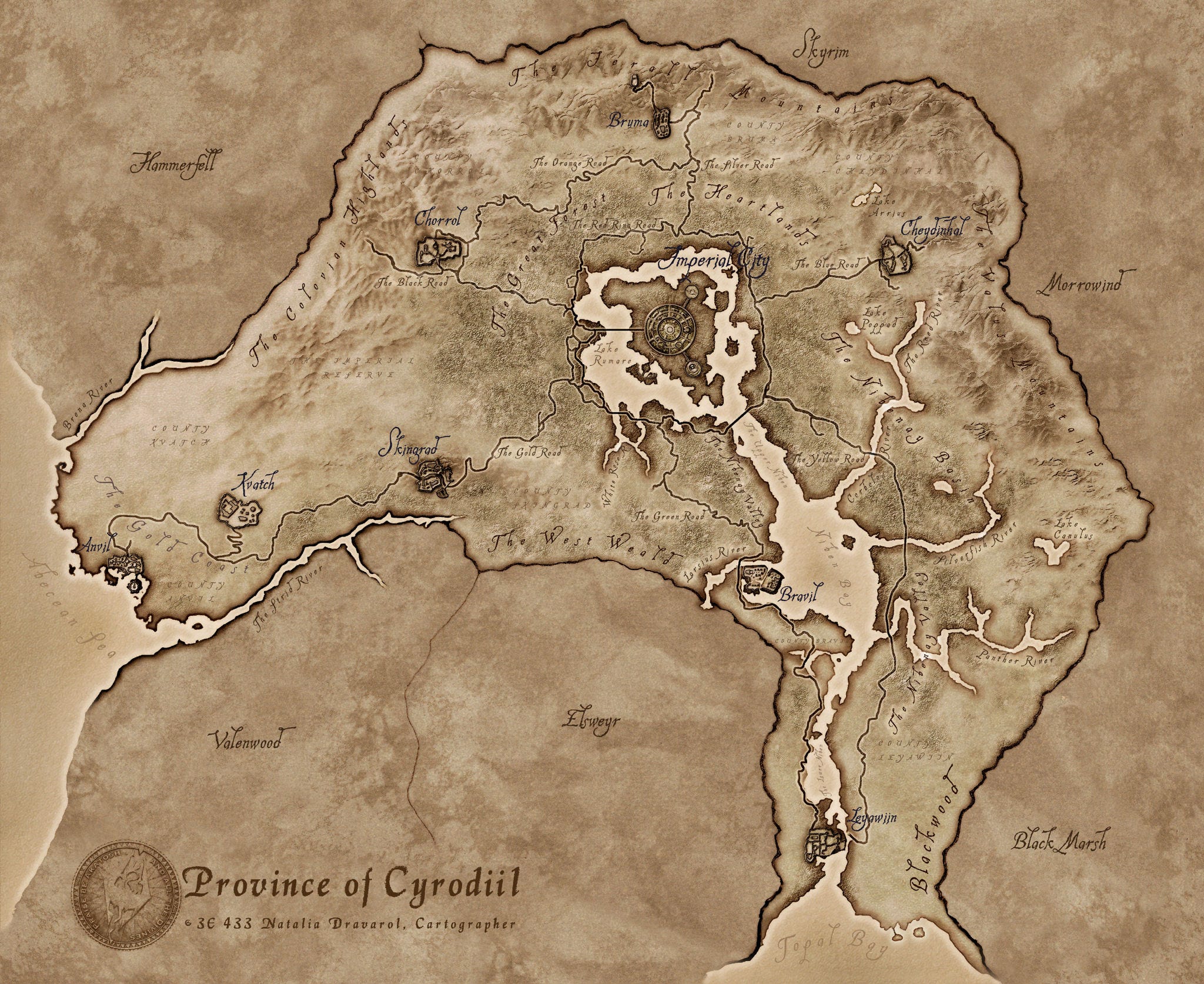
With this fine map, Skyrim was following in its predecessor’s footsteps. Oblivion included a similar printed map by the same fictional cartographer, showing the province of Cyrodiil, heart of the Empire.
The Witcher 3
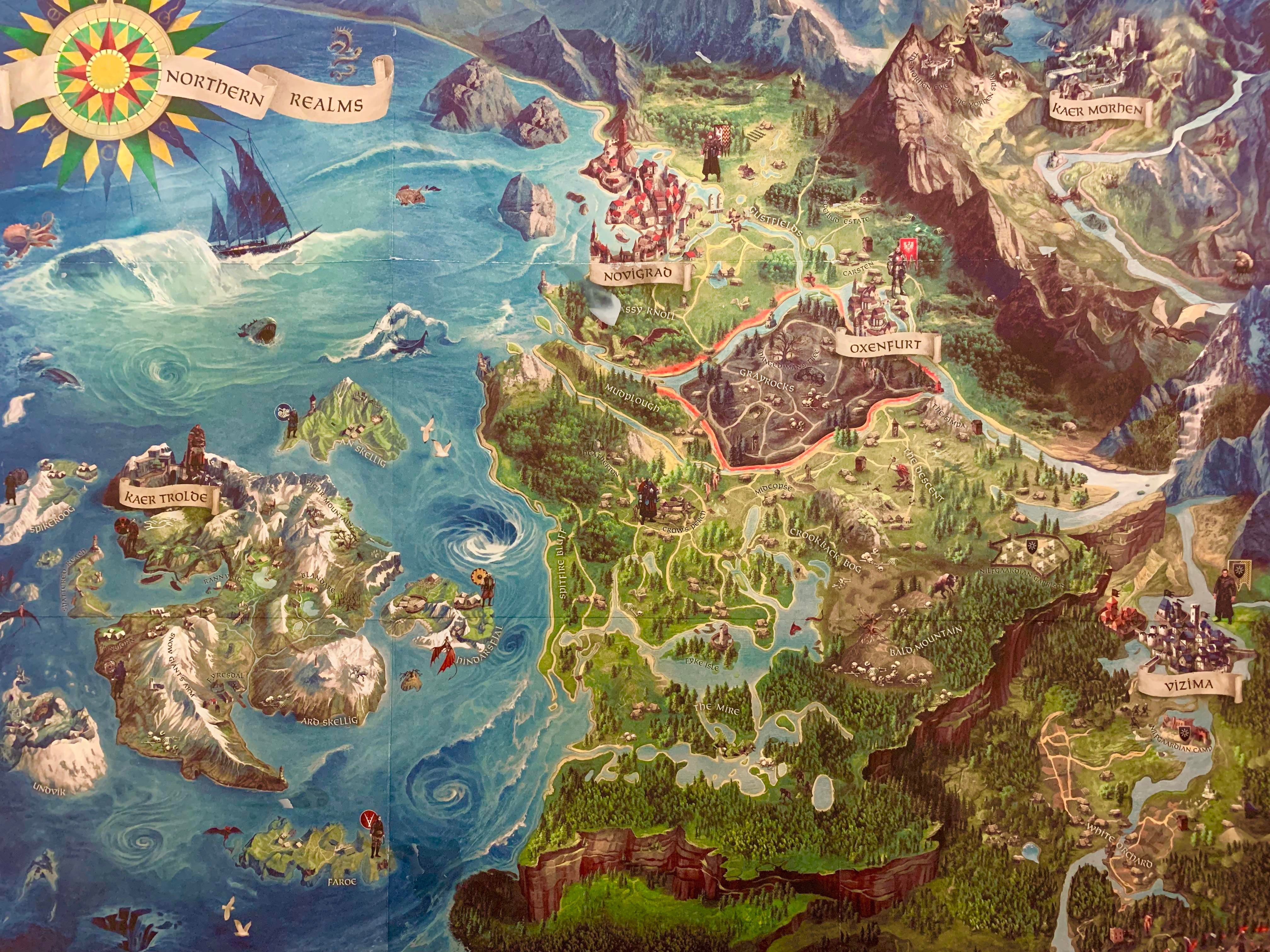
Given the long-established relationship between maps and the fantasy genre, and the emphasis on adventure, discovery and exploration in roleplaying games, it’s perhaps unsurprising that The Witcher 3 would take a leaf out of Bethesda’s book, including an especially handsome and colourful map in its box.
Contrary to the heavy geopolitical overtones of The Witcher’s narrative, its map is quite loose and more vibes-based. The lands of the North are shown as densely populated by monsters, grim-looking soldiers, and general ne’er do wells, all as lovingly realised on paper as in the game. It’s a great preview of the art style’s incredible quality, giving the player a tantalising sense of the sheer scale of what they are about to experience.
Red Dead Redemption 2
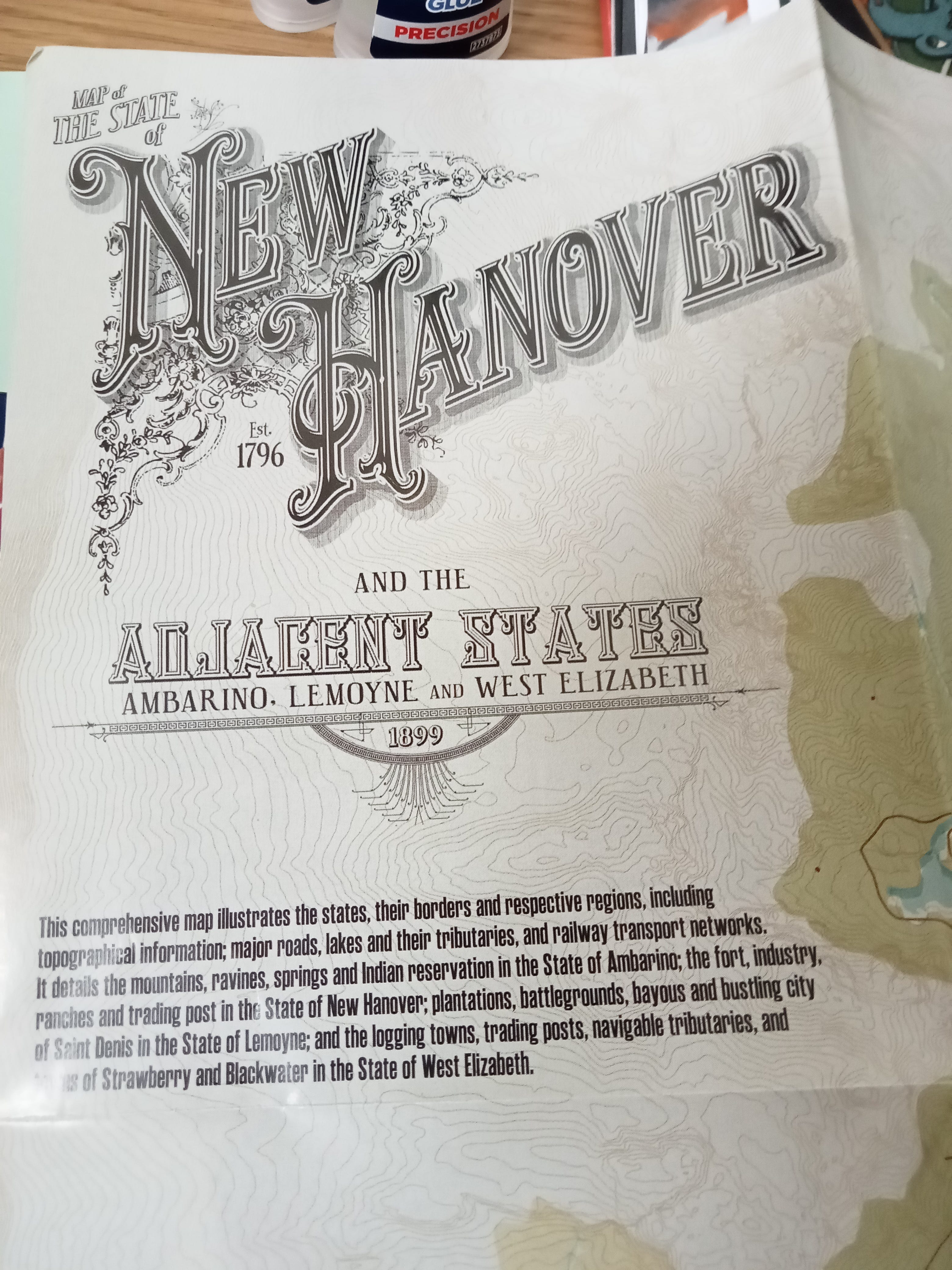
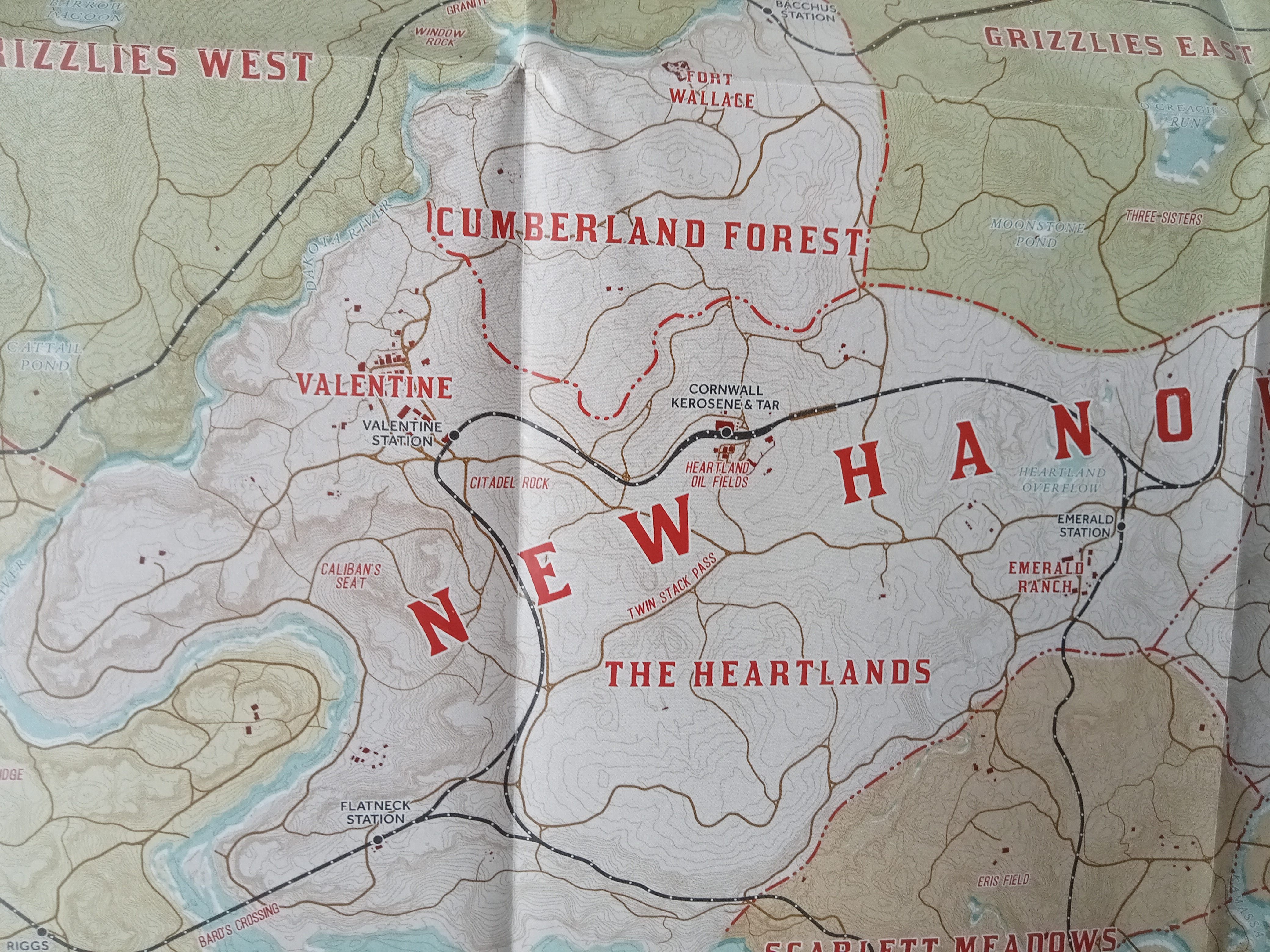
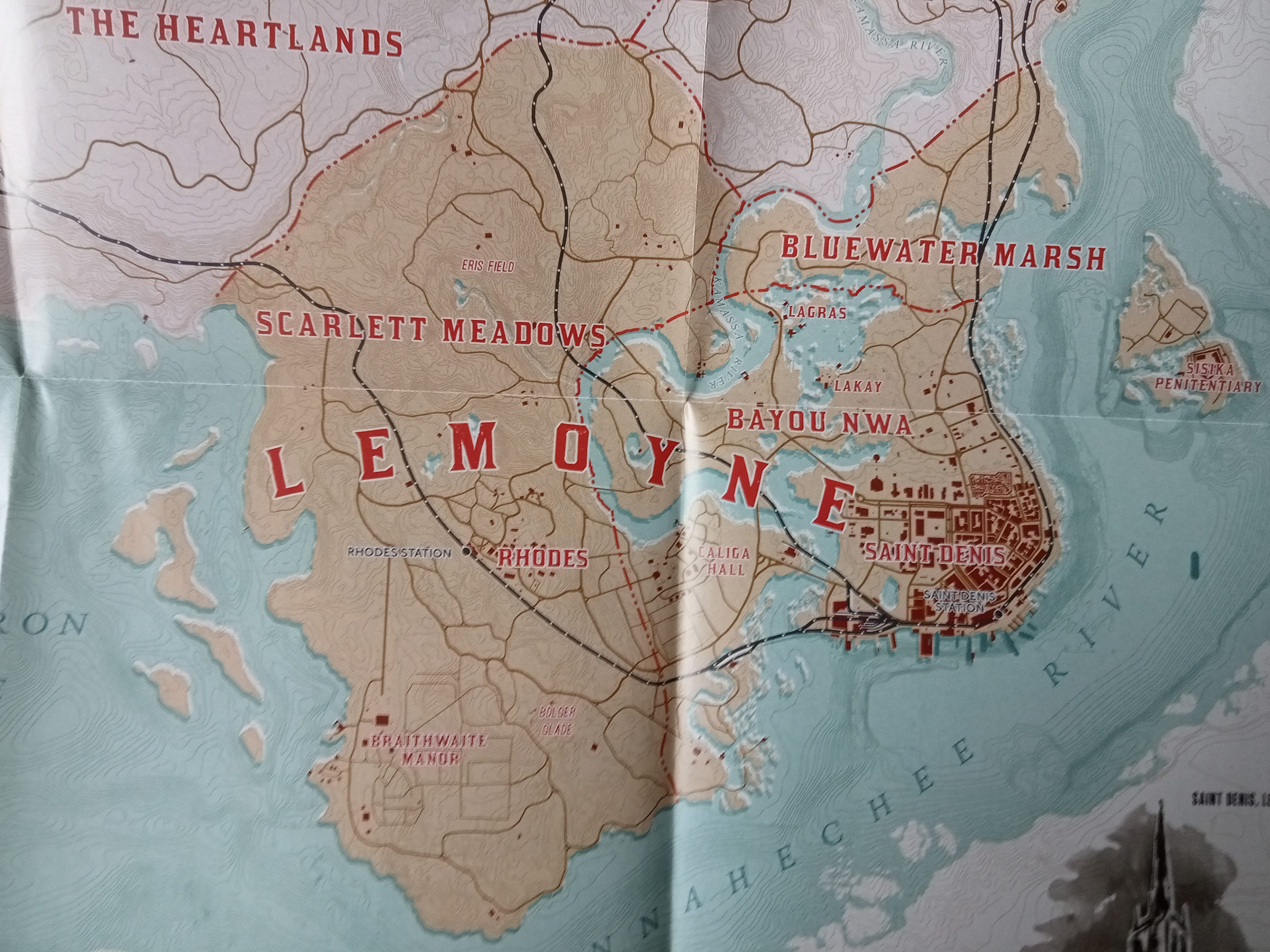
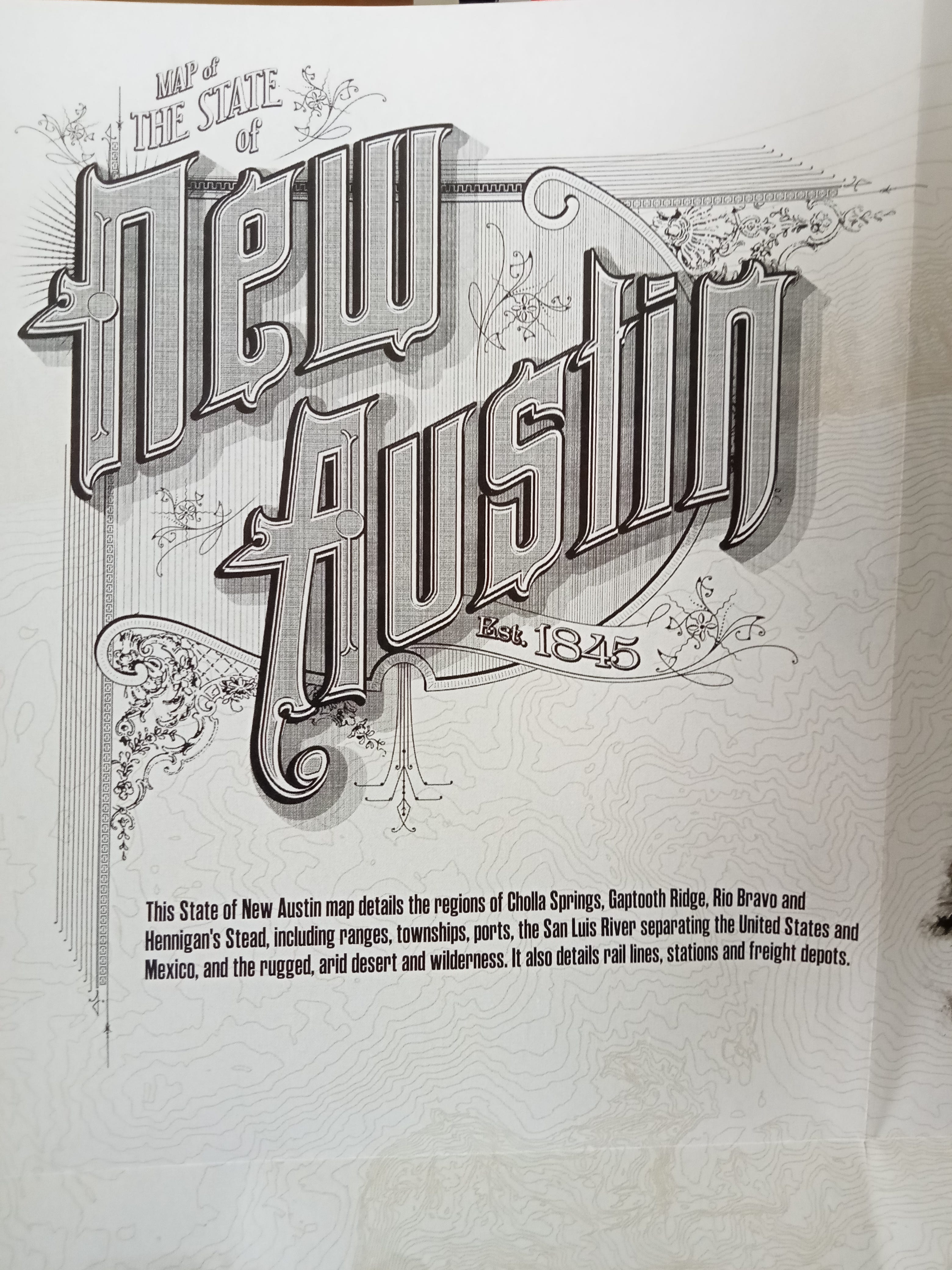
Speaking of scale and quality, Red Dead Redemption 2 would also include a very impressive map rendered in a fussy 19th century style, all precise lines and contoured landscapes, and bordered all around with black and white pictures of landmarks from its fictionalised vision of Gilded Age America. The map is double sided, showing the south-western state of New Austin (John Marston’s original stomping ground) on the reverse, which has a special significance for fans of the first game.
In RDR2’s map, there is a nice resonance with the story’s central conflicts - in the map, we can see the romance of wide open spaces in a state of tension with the cartographer’s impulse to impose limits and establish ownership.
Charts
Maps aren’t the only artifacts we can discover in game boxes. For me, two printed charts also spring to mind.
Metro Exodus
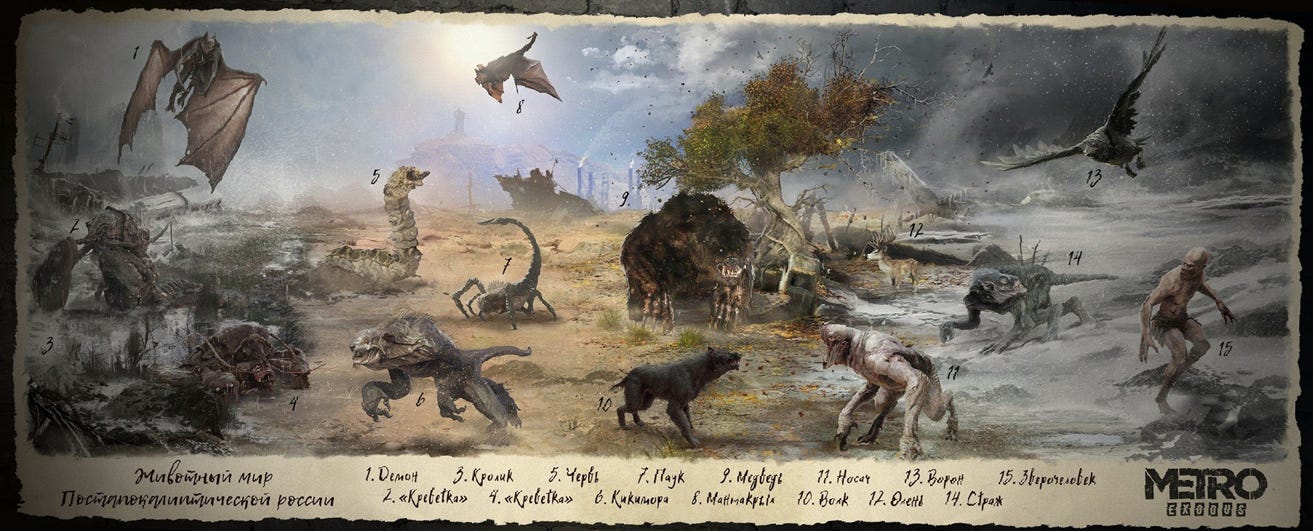
Metro Exodus, the best two-legged Watership Down simulator on the market, has many things going for it. It’s intensely Slavic, people ramble about Dostoyevsky, your wife gets a horrible respiratory disease, and much of it takes place on a Soviet steam train. What it also has, though, is an inspired menagerie of post-apocalyptic wildlife, largely carnivorous, and this roster of creatures was the basis for a handsome printed chart.
From the winged demons that rule the skies, to the giant shrimps that infest every waterway from Moscow to Vladivostok, the whole gang is here, and all are nicely labelled with their names in cyrillic letters.
Fallout 4
Fallout 4, it must be said, has many things wrong with it. Is it an okay action-adventure game? Sure. Is it an RPG? Absolutely not. Is it a good Fallout game? Not really, no.
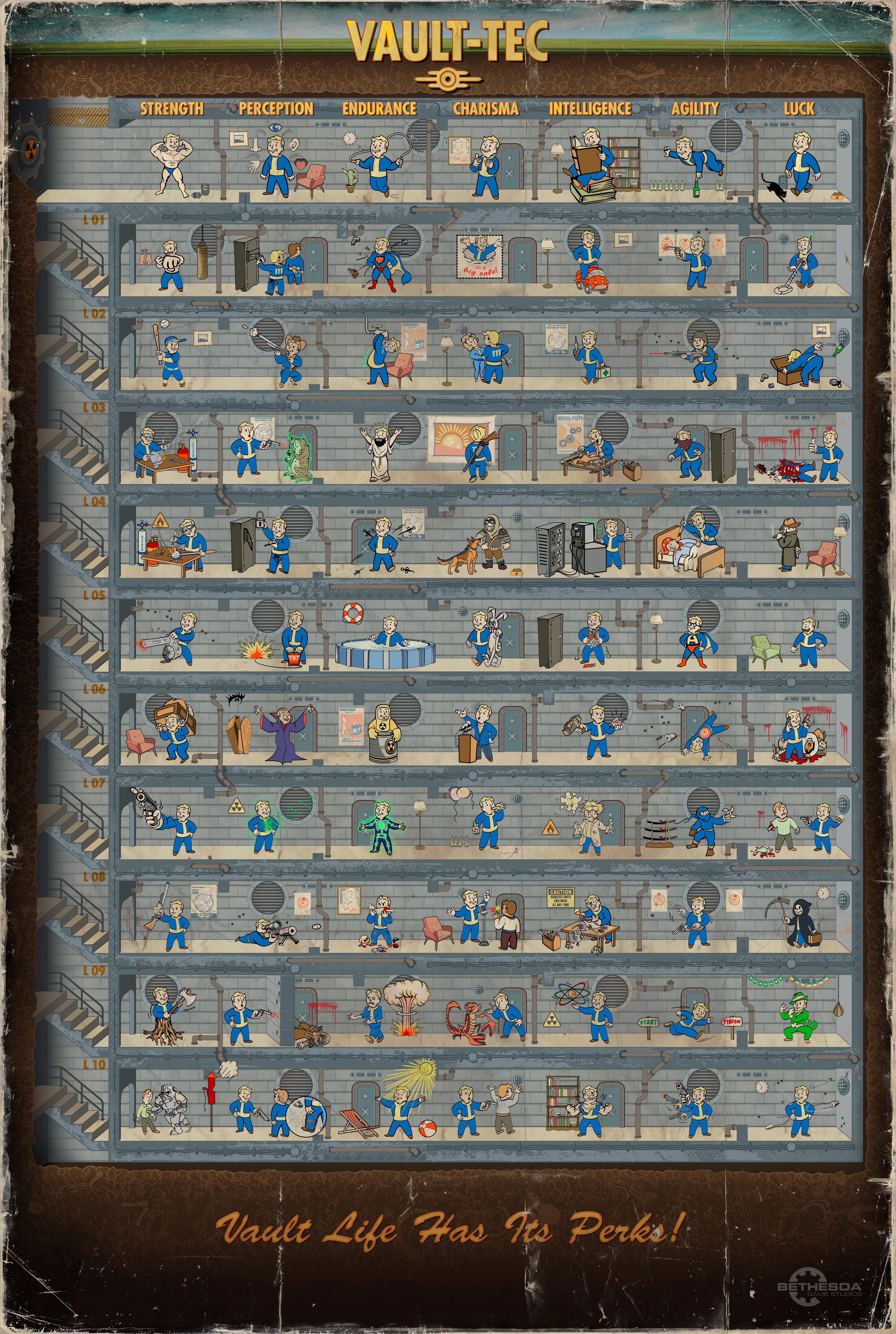
But if we can say one thing for Fallout 4, it’s that it does look nice, and it’s obvious that a huge amount of work went into its in-game art, from the interfaces, to the magazines, to the whole-ass retro minigames playable on cassette tapes for the Pip-Boy.
The game’s fully-animated perk chart, seen on the level up screen, was rendered as a lovely full-colour poster, with a nice sturdy quality to the print.
Reversible covers
The reversible cover was (the past tense somewhat saddens me) also a fairly common design feature of the video game box, often used to great effect. Typically, the ‘standard’ cover of the game would be a more commercially oriented design, crowded with titles, taglines, credits and calls to action, while the inner side would be more aesthetically oriented.
For example, Fallout 4’s standard cover shows the power armour helmet, with a back full of text, while the reverse is a panorama of the wasteland, with a Vault-suited protagonist gazing out towards the iconic Red Rocket gas station, dog in tow. As with a map, there’s a sense of freedom and adventure, of a new world to discover.
Mass Effect 3 would also make good use of the concept, allowing the player a choice of two covers showing either the standard male or female Commander Shepard, as you prefer.
For me, though, the reversible cover that sticks in my mind most is the one that has been stuck to my bedroom door for several years. Bioshock Infinite has a fine but unremarkable front cover, but the reverse? Holy shit.
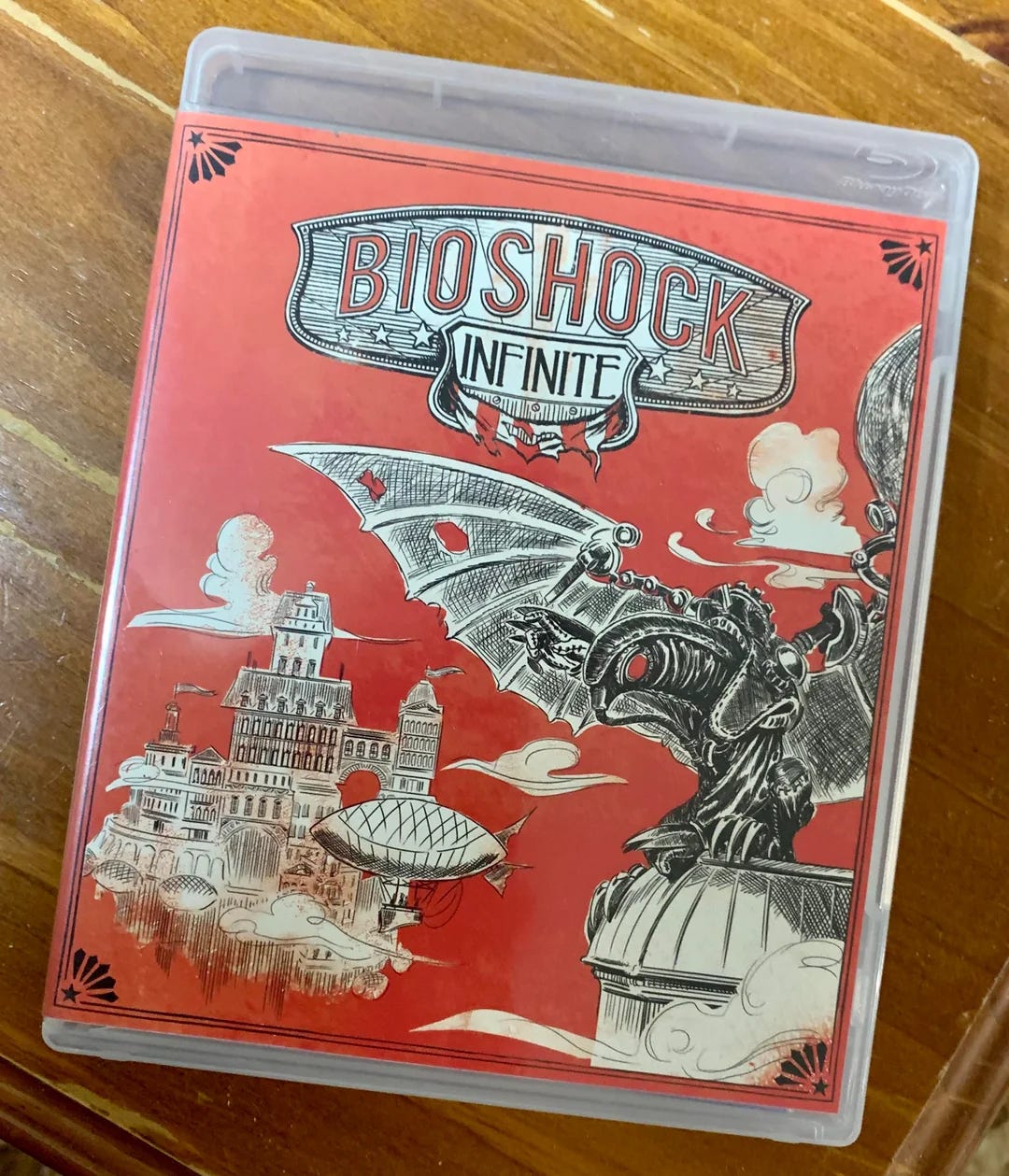
This gorgeous scarlet and monochrome version of the cover foregrounds Songbird, the tragic biomechanical giant, with the false-utopia of Columbia among the clouds in the background.
Adornments frame the text and pictures, and on the back we have the key quote that the game opens with:
The mind of the subject will desperately struggle to create memories where none exist.
This is, of course, a mild spoiler to clue the player in on Booker’s unreliable-narrator status, and really deserves to be centred on the cover, as it is on the reverse.
The Proto-Steelbook
Steelbooks have been fairly ubiquitous in games and DVDs for a long time, peaking in the 2010s. Some people hate them, for reasons somewhat obscure to me - I myself own only one, of an early type, but it happens to be enough of a treasured possession to deserve a mention here.
The Force Unleashed: Ultimate Sith Edition
This is not the first time in recent months that I have written about Star Wars: The Force Unleashed. In a previous article on horror in non-horror games, I touched on TFU’s horror-infused ending, in which the hero is transformed into a terrifying cyborg servitor, taking Darth Vader’s place as the Emperor’s chief enforcer.
This doomed non-canon ending became a springboard into a dark mirror-universe, in which the heroes of the original trilogy are hunted down by the new Sith Lord, and all hope is lost. The expansion missions were available by download, but also through a special ‘Ultimate Sith Edition’ (tm), featuring a stylish steelbook box loaded with goodies.
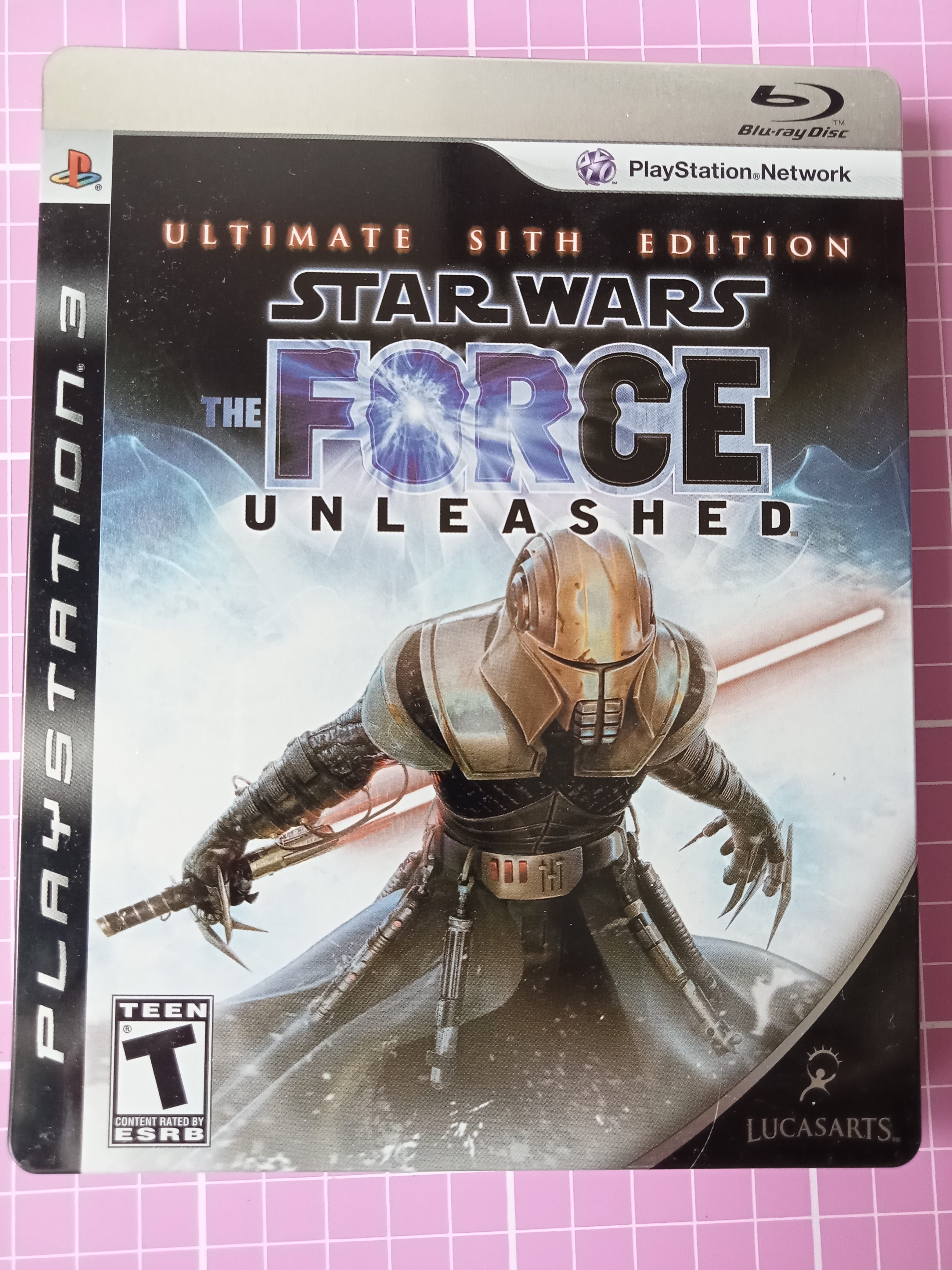
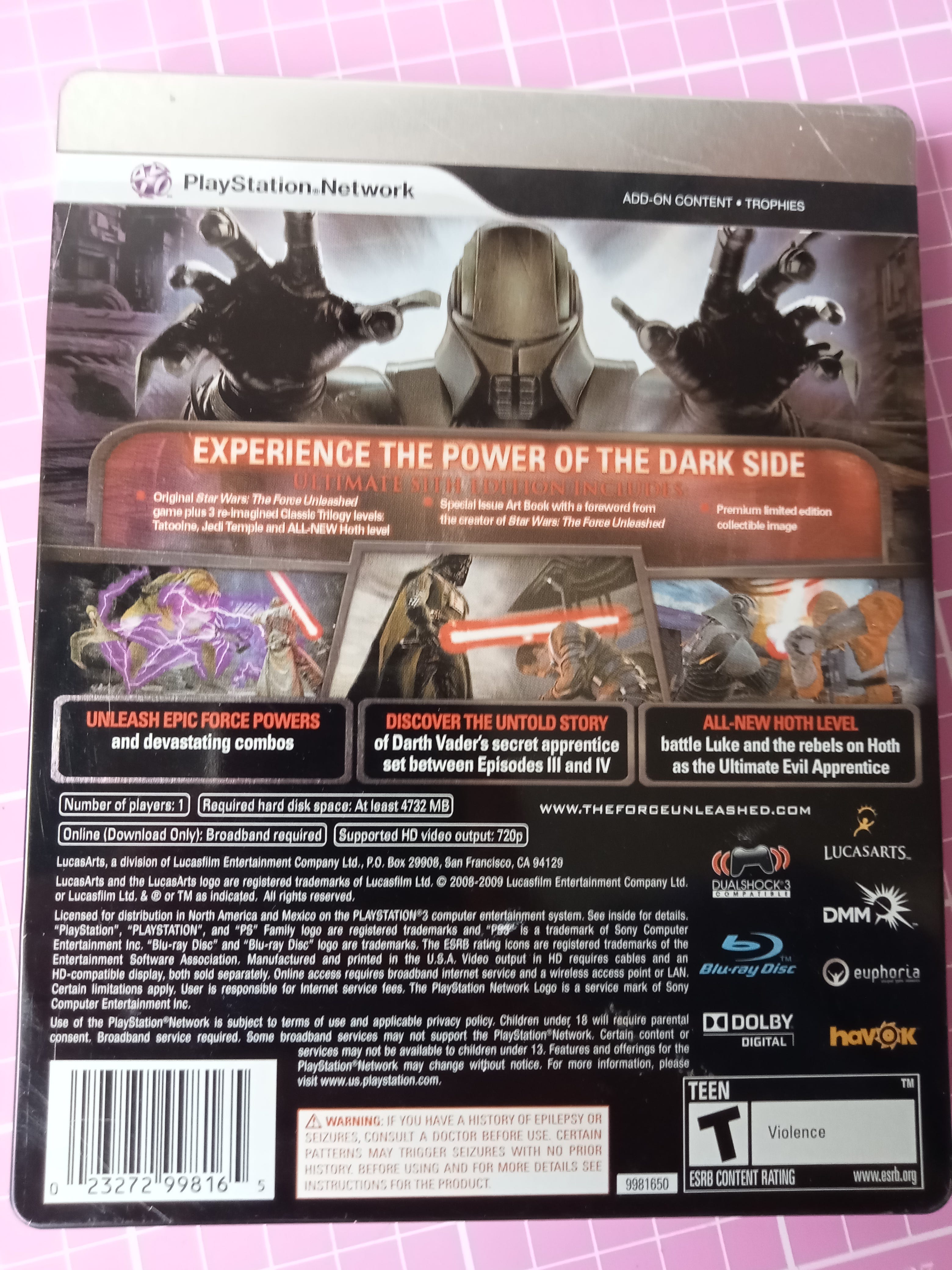
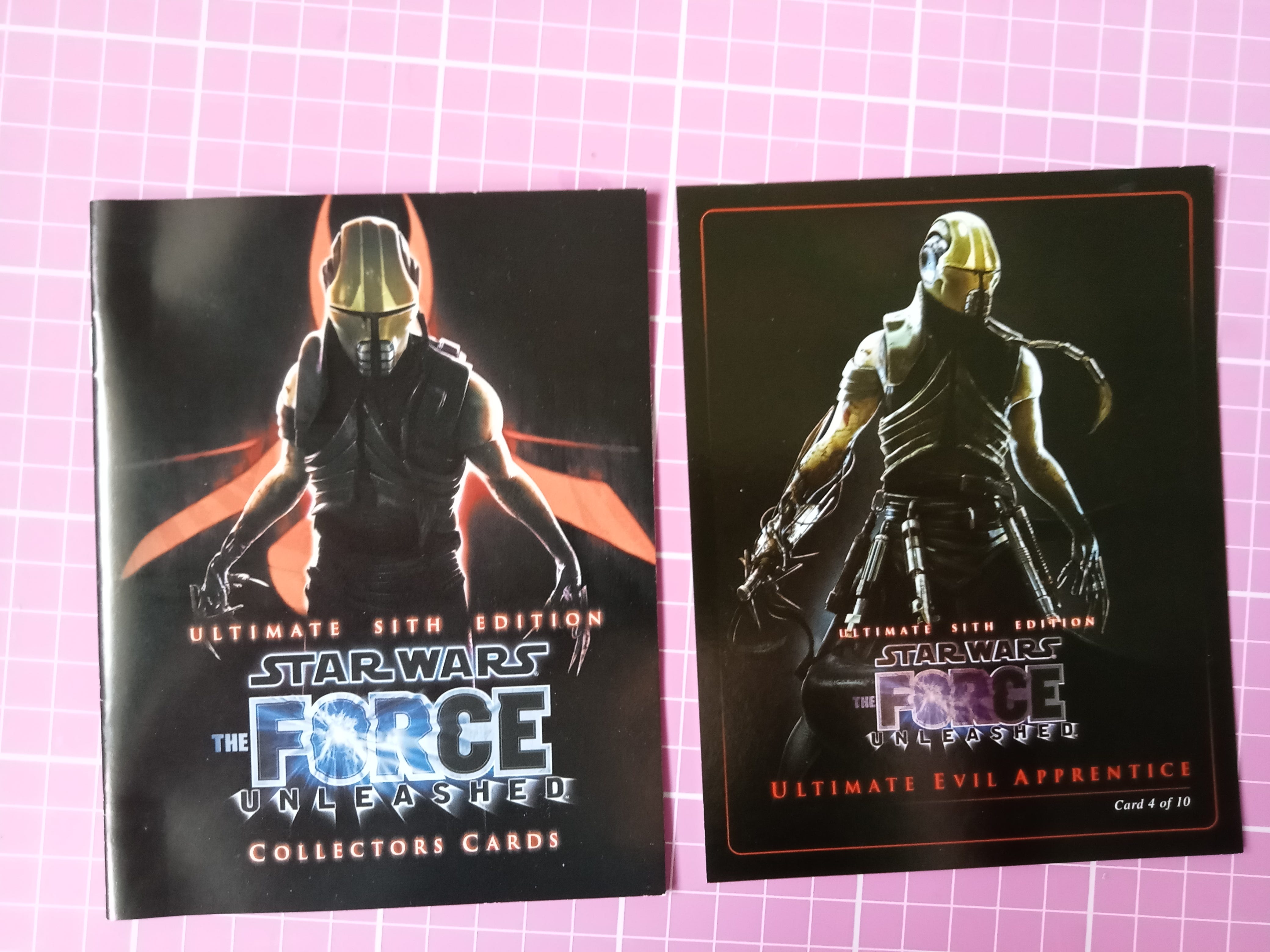
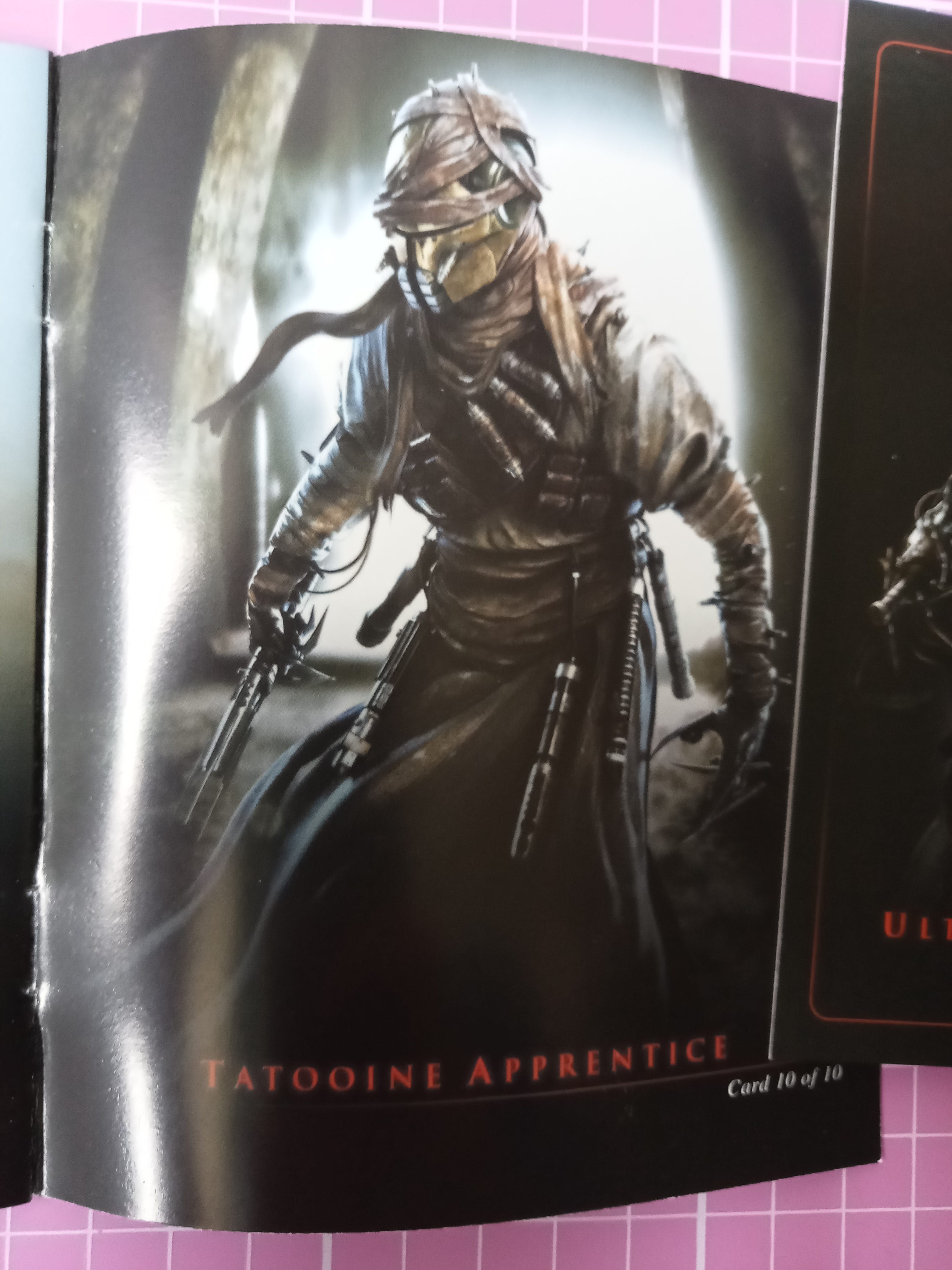
Most notably, the special edition features a small art book with a foreword by the game’s lead writer, discussing the ideas (‘What if…?’) behind the expansions and the design process. This book shows a series of paintings of various iconic characters from the game, most notably the hero’s cyborg character designs. Each box had one of these paintings as a special lithograph on card, and I was lucky enough to get one of the best.
Closing thoughts
While I can’t help but feel that the loss of physical games is a loss, I would not want to end this on too downbeat a note. So, what I will say is that, whatever the big companies decide to do (short of killing us with robots), the demand for tangible representations of the games we love will remain, and the market will hopefully rise to meet it.
There is already a huge, thriving industry for fanart, be it hand-crafted, traditionally printed, or indeed 3D printed, and that industry isn’t going anywhere. I suspect that, with the loss of physical games, we will see more and more fanart by way of compensation.
We’ve seen similar things before with the loss of physical music - on markets like Etsy, I often see retro mock-ups of video game soundtracks on cassette tapes, and video game themes on music boxes. Perhaps in the future we’ll see mock-up game boxes from upcycled DVD cases, with original painted covers?
As Jeff Goldblum used to say, life finds a way, and while there’s life, there’s art.
Though to be fair, it’s pretty low down my long list of major and mild shames. We’ll all be dust one day, but plastic is eternal, and in every organ of our bodies 🙃
Thanks for the mention, and for generously characterizing my post as 'sensible.'
I have to echo yeshuap and say that the best, or at least most memorable map bundled with a game for me has to be Morrowind - no game before [or really after] actually felt like I could GO to any place on the map, or that the map would be USEFUL as an orienteering tool, the way Morrowind's was. With no instant point-and-click fast travel, the in-game map getting revealed in detail only as you explore, even whole settlements obscured if you've never visited them, I spent a lot of my time on my first playthrough with the physical bundled map actually at my side, often propped open on a tabletop music sheet stand so I could tell which foyada a questgiver had told me to pass through, see where the nearest settlement might be, know when I'd gone too far and needed to loop around. And then when I started modding, and realized the whole landmass of the game, all fully traversable and potentially interactive, could also be freely molded, it took on even more meaning. Outstanding.
As an old timer I LOVED just cracking open manuals and reading them on the way home from buying them. They used to have so much lore. The Warcraft/Starcraft manuals had long lore explanations of each unit as well as overall story.
The Morrowind physical map was brilliant, bursting with color and extremely useful figuring out how to get places, literally had it in front of me.