On Reply Guys/Addendum to TDOS
A factual error + doubling down + examining the rude

Last week, I published a post on The Death of Stalin, a film that I found thoroughly unimpressive, and even more so after doing some reading. Without wishing to get too bogged down, TDOS takes big liberties, such as the invention of multiple massacres, and the reduction of two historical figures (both women) to insipid sock puppets, all of which I felt was a bit shit. For me, it wasn’t funny enough as a comedy, impactful enough as a drama, or truthful enough as a historical picture. One respondent described the film as ‘smug and self-important,’ words I had not used in my article, but which I had used while yapping offline, so shoutout to that guy for Getting It.
I think my post is mostly good, and it is not dramatically different from anything else I’ve written here. What was different was the response: within forty-eight hours, I had received four quite nasty, dismissive, reductive comments, all couched in similar tones of arrogance and condescension, all willfully missing the key points of a nearly 4000 word article, and all but one from accounts I had never interacted with. On the other hand, I received a grand total of two nasty comments in the whole previous year of posting, and not for lack of inflammatory takes.
Of course, there were also civil responses (some agreeing, some disagreeing, some mixed), but the snotty ones were the ones that stood out. What surprised me most is that I genuinely wasn’t trying to ragebait (this apparently comes to me effortlessly), and I did not expect this to be such a polarising take.
What I will say is that there is a mistake in my article that undermines some (not all) of the conclusion. Based on the film’s advertising and the discourse around it, I always assumed that Iannucci was using it as a proxy to criticise Trump, which I took issue with, because in my view these are fundamentally dissimilar figures, and it’s a bit lame to pick as safe a target as the Soviet Union and then advertise your film as subversive.
However, Iannucci says that the film’s writing was finished pre-Trump, in which case my understanding was wrong, and I was mistaken about the intent of the film itself.
While denying intent, Iannucci has nonetheless entertained the Trump-Stalin comparison many times,1 which to me is irritating, because it seems (I know that’s a weasel word, but this is intuitive, I am not doing science or legal prosecution here) an attempt to brand a very safe and mainstream film as punk rock, and to capitalise on Trump’s notoriety. Those who like the film may consider this bad criticism from me, as this is exterior to the film, but I don’t know that something labelled as a political satire can be totally removed from its contemporary context, and how things are labelled inevitably affects our expectations and response.
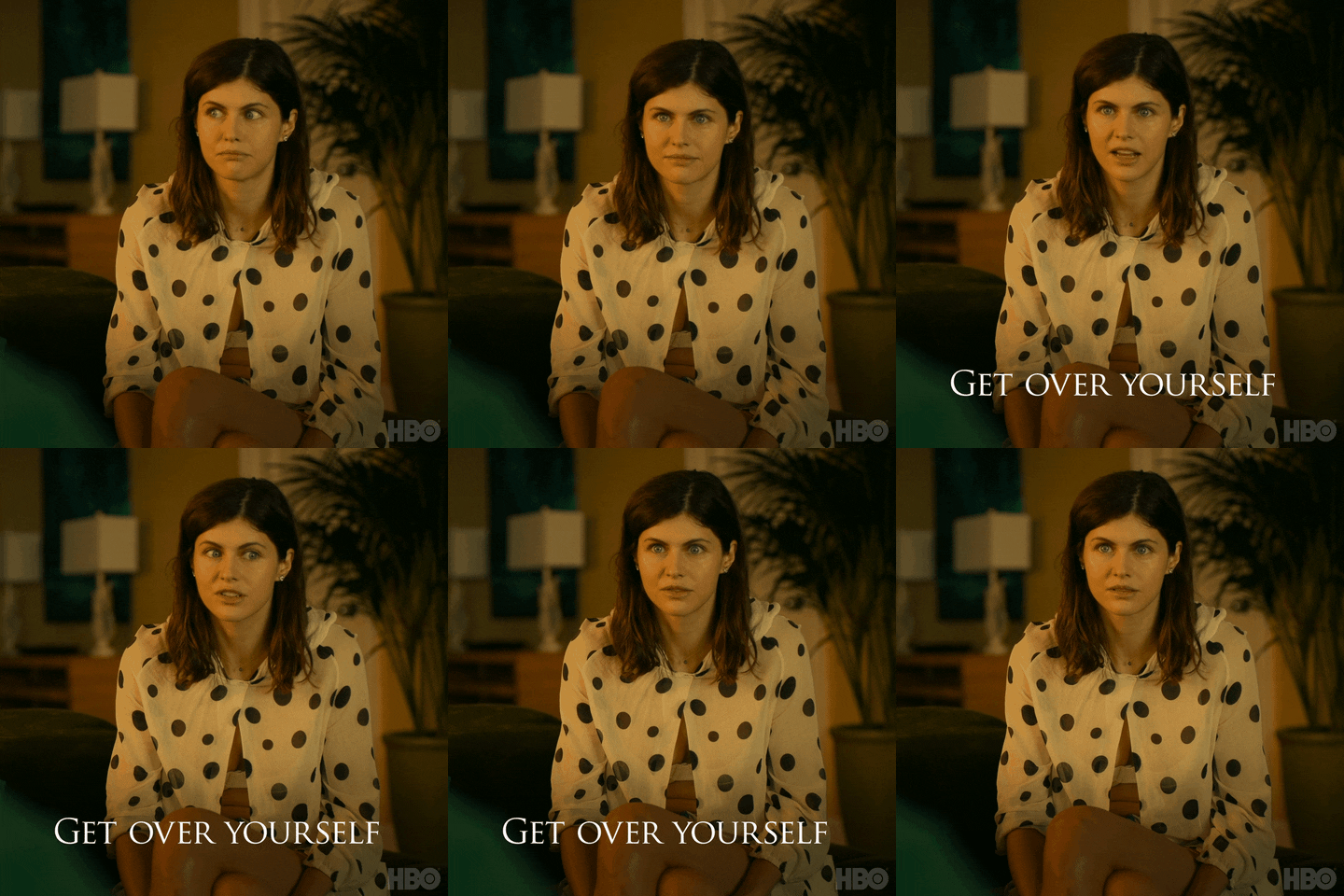
More importantly, if it had made me laugh, or feel something, or both, I’d surely be willing to carry more water for it, and to forgive the director his brand-building (however annoying).2 So, to all of those guys who told me variations of ‘it stands on its own’ or ‘it’s dramatically/comedically justified’ -
Regardless of the details, I could have been informed of the mistake more politely, and the one useful comment was still rude and condescending. I try to be a genial host, and have had plenty of good-natured discussions here before, but none of these responses left room for that kind of exchange.
Now, obviously, a few snide remarks is nothing in Internet terms, and the correct approach is simply to block and move on, and this I am doing. However, I want to examine these comments and commenters, because there is something going on with the compulsive need of some guys (and they were all guys) to be snotty and unpleasant, and to try to turn everything into a competition. If nothing else, it’s easy content, and will hopefully be amusing to the OGs.
Commenter A
This guy was a long-time subscriber who had never previously been in touch, but was quick to reach out to inform me that I had committed ‘a bad take.’ This is itself an alien mindset to me: if I mostly enjoyed someone’s work and respected their opinion, would I bide my time for many months until I had something negative to say before making contact, to make sure that was the one thing they remembered about me?
Undeterred by civility, A soldiered on. He clearly had not read the post, and was responding only to the announcement note, which offered a three-sentence introduction to some of what I had to say. Nevertheless, he felt qualified to pass judgement on the 4000 words that he had not read, and expected me to defend them, which I couldn’t really do in a reply thread - if I could, the post would have been far shorter.
In particular, he disliked my note’s reference to Trump: he had never thought of Trump while watching the film, therefore I was wrong to link the two. I did make a mistake here re. intent, though it was promoters and interviewers that attached the film to Trump’s coattails, and whatever you think of the parallel they attempted to draw, it seems to me a sign that the film lacks the quality to stand on its own merits.
A also dismissed my concern for historical accuracy out of hand, though the lion’s share of the article was taken up with explaining why I was bothered by inaccuracies in this particular context. His argument was that the changes were comedically justified: again, I don’t agree, and if you look up contemporary reviews, you will find plenty agreeing that the film is less funny than it thinks it is.
This commenter, in arguing that Trump is different from Stalin (something that I myself had said in the post), said that ‘Trump doesn’t have power of life and death.’ This seemed a tasteless thing to say the same week ICE agents started filming themselves murdering people in broad daylight, and betrays a stunning lack of interest in people and in the world that we live in. This convinced me to make A my fourth blocked subscriber this year (the other three were far-right weirdos who had taken a wrong turn).
Commenter B
Similar to A, but more patronising, and had maybe read at least some of the post in question, but still managed to get it almost completely wrong. He did correctly identify my misreading of an interview, so a point for that, but he was a dick about it, so point deducted.
This one was distinguished by the fact that he was clearly pretty right-wing, but sort of pretending not to be. His notes were riddled with complaints about ‘progressives driving people to the right’ (as if he needed any help getting there), takes about how people should not follow the news, ominous comments about his interest in WW2,3 etc. He has eight subscribers, and his most recent post is about being a proud ‘WASP’ and how this makes him better than other people (even other white people…).
It amazes me how people just say these things out in the open and don’t realise how weird and disqualifying they are. How can anyone respect the opinion of a guy who is apparently invested in a variety of racism that was becoming outmoded by the end of the 19th century? I am shaken by the fact that men exist who will call my review ‘odd’ and then drop a WASP supremacism piece in the same 24 hours.4
Paraphrasing, the core complaint was ‘it seems like you think all art must have a clear and intentional political message.’ Now, this is a sweeping conclusion to draw from a closely argued essay about one particular thing, and regulars will know that this is not the case. If we’re talking about art in general, I’ve often praised ambiguity and moral uncertainty (these were themes of the previous week’s post), and criticised stories that are overly didactic and condescending to the audience.
However, we are not talking about art in general here. We are talking about a self-described political satire, which are almost by definition supposed to have a point, and to deliver some kind of social criticism in a funny way.
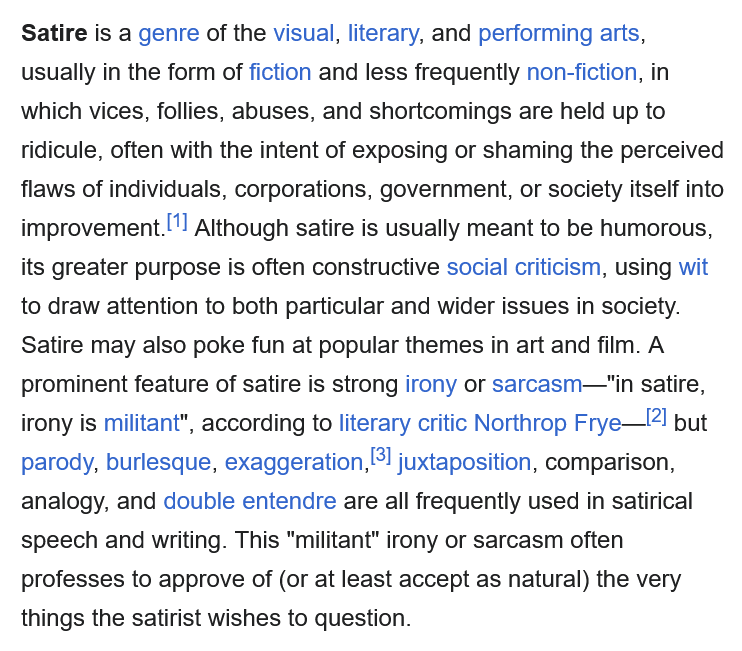
So, no, I do not think that ‘all art must have a clear political point.’ I do, however, believe that a political satire should have some contemporary relevance and backbone, and should not just be bashing 1950s Russia (in fact, not even 1950s Russia - a distorted, contextless strawman of 1950s Russia). Moreover, my complaint with TDOS isn’t that it doesn’t have a point: it’s that it has a very banal point - ‘dictatorships are bad’ - and it doesn’t communicate this in a funny, affecting or truthful way.
It’s transparent to me why someone with the ‘I am a proud WASP’ politics of this commenter would devalue social criticism - because it tends to be directed at people like him.
Commenters C & D
These two were almost carbon copies in style, tone and content, which is more instructive than either comment on its own - this uniformity is, to me, the surest sign of the Twitter-brain, which is chemically conditioned to take raw material, boil it down, evaporate 99%, and reduce it to a catty little put down for easy digestion.
It’s actually a very ‘feminine’ thing (and by that I mean stereotypically, not that women are actually more prone to this; I don’t think they are), which is quite interesting, as both of these comments were from guys, of course. Every accusation is a confession, and perhaps men have been projecting their own repressed desire to be cunty little divas onto women. It would explain the invention of drag.
In any event, comment C went something like:
‘This essay should be called ‘The Death of Stalin: It’s Not Perfectly Accurate.’
and D went:
‘Next review, Jesus Christ Superstar is Historically Inaccurate.’
Which… yeah, okay girls, you got me, but can you not see how Twitter-brained these responses are? Most of the essay consists of explaining my problems with the inaccuracies, but these put-downs don’t acknowledge any of that, most likely because they did not read beyond their knee-jerk response.
To be clear, I don’t want accuracy for accuracy’s sake - I want accuracy because jokes are funnier when they are based on truth, and because subject matter like this should be handled responsibly by people who know what they’re talking about, and who understand the implications of building a foreign/communist bogeyman.5 Why bother depicting historical figures at all if you strip them of all the context that makes their stories meaningful?
Closing thoughts
So, what can we conclude from all of this? That I was over-hasty and made a foundational error, based on confirmation bias, and on my finding Armando Iannucci smug and irritating on a personal level? Yes, but you see, he went to both Glasgow and Oxford universities, looks like a devious Roman senator, and does a podcast with a classicist who won’t stop going on about Cicero, so really I’m doing quite well by not sending him hate mail.
More seriously, it is never my natural impulse to provoke or offend (if it was, I would probably have more subscribers by now), and I really did not anticipate this one being so divisive. Having grown up with a volatile alcoholic who regularly threatened suicide, I do not enjoy confrontation, and, this being the case, the readership I’ve cultivated is for the most part very decent and tolerant. There’s a reason I never tried to promote this thing through gladiatorial platforms like Twitter, whose userbase is not really compatible with the kind of writing I find worthwhile.
Therefore, take my subjective complaints about culture in good part, read before commenting, and if you still feel moved to respond, be a good sport about it, and make the same allowances that you would for any other crazy person.
(See: his podcast, his social media, various interviews. I can’t give episode numbers for the podcast, because I found it unlistenable and going through it again is too much effort for a Substack post. It came up at least once in the two episodes I listened to. Variety has many interviews with him, many touching on TDOS, and most mention Trump in the preamble, so you can forgive me for the misread.)
I watched Werner Herzog’s Nosferatu last year, and liked it so much that I can almost forgive the director for boiling several hundred live rats, so let it not be said that I am overly intolerant of art by people I find personally offensive. Animal cruelty is significantly worse than having a slightly annoying vibe.
Of course there are legitimate reasons to study any period of history, but there are times when WW2 buffery is a red flag. That famous clip from Succession springs to mind.
Similarly, I once received a nasty comment on my piece on Bakshi’s Lord of the Rings, which wasted no time in sneering about Aragorn being depicted as Native American, a detail I had not even mentioned in the post. Again, astonishing that these guys just fold under no pressure and out themselves, and don’t realise how disqualifying this is from the point of view of most people.
See: the recent hysteria over Mamdani’s very mild social democratic pitch, and the ludicrous claim that the US needs to annex Greenland to prevent Russia from annexing Greenland. If you doubt that there are hundreds of millions of people who form their worldviews based on pop culture like TDOS, I envy your optimism.