

Space Hulk: Deathwing - A Horror in Shooter's Clothing?
Step through the wormhole to 2016 with me...

Other sci-fi writings can be found here.
Unless noted otherwise, images are my own screenshots.
Note that this article is written with a general audience in mind, not just those familiar with the (old/obscure) game or (impenetrable) source material.
What is your duty? To serve the Emperor’s will. What is the Emperor’s will? That we fight and die. What is death? It is our duty. What is your duty?…
Introduction
Space Hulk: Deathwing is a first-person shooter originally released in 2016, set in the Warhammer 40,000 universe. Why am I writing about a little-known game from Trump’s first term in the Year of Our Lord 2025? Don’t ask such rude questions!
In all seriousness, the reason behind this post is that I feel that this game is much, much better than people gave it credit for. It offers both a uniquely atmospheric experience in its own right, and a particularly memorable take on the 40K setting. Is it topical? No, but then again, the source material for Deathwing is a board game from 1989, so the 2016 release wasn’t exactly topical either, nor were the multiple previous Space Hulk video games. I am not quite sure where sporadic Space Hulk video game releases1 fit on Maslow’s Hierarchy of Needs, but they do seem to have a niche there. The IP’s history is one of perpetual optimism, since many of these sold poorly and were critically panned (rightly or wrongly), yet it clearly possesses a strange magnetism for developers.
I should acknowledge here that my thoughts on the game must be taken with a pinch of salt: I am, after all, an apologist for 40K, and for all things strange and imaginitive, and Deathwing is all of the above, so I’m predisposed to give it the benefit of the doubt. But, as a wise gay cannibal once said:
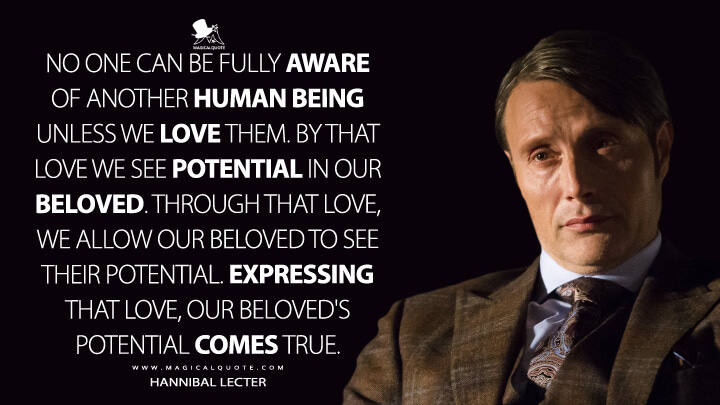
Similarly, I feel that a cold, uninvolved critical standpoint (if such a thing is even possible) is not always the best way to engage with media. Sometimes, to get the most out of a work of art, we have to approach it with an open heart and mind, and a willingness to examine breaches of convention with curiosity, rather than condemning them out of hand.
Also, a skim of contemporary reviews suggests to me that the game was fundamentally misunderstood at release, largely because it was being assessed by critics who were both a) dismissive of the source material, and b) too normative in terms of their expectations of Deathwing’s narrative and gameplay, both of which are, as we’ll see, closely linked.
But before we get into the tepid reception, it’s sensible to start with a look at the original Space Hulk board-game, the foundation on which Deathwing was built.
Space Hulks and you
What is a Space Hulk, and why do we care about them? Well, in this sprawling gothic universe, a space hulk is a mass of derelict spaceships, lost for centuries before being rediscovered.2
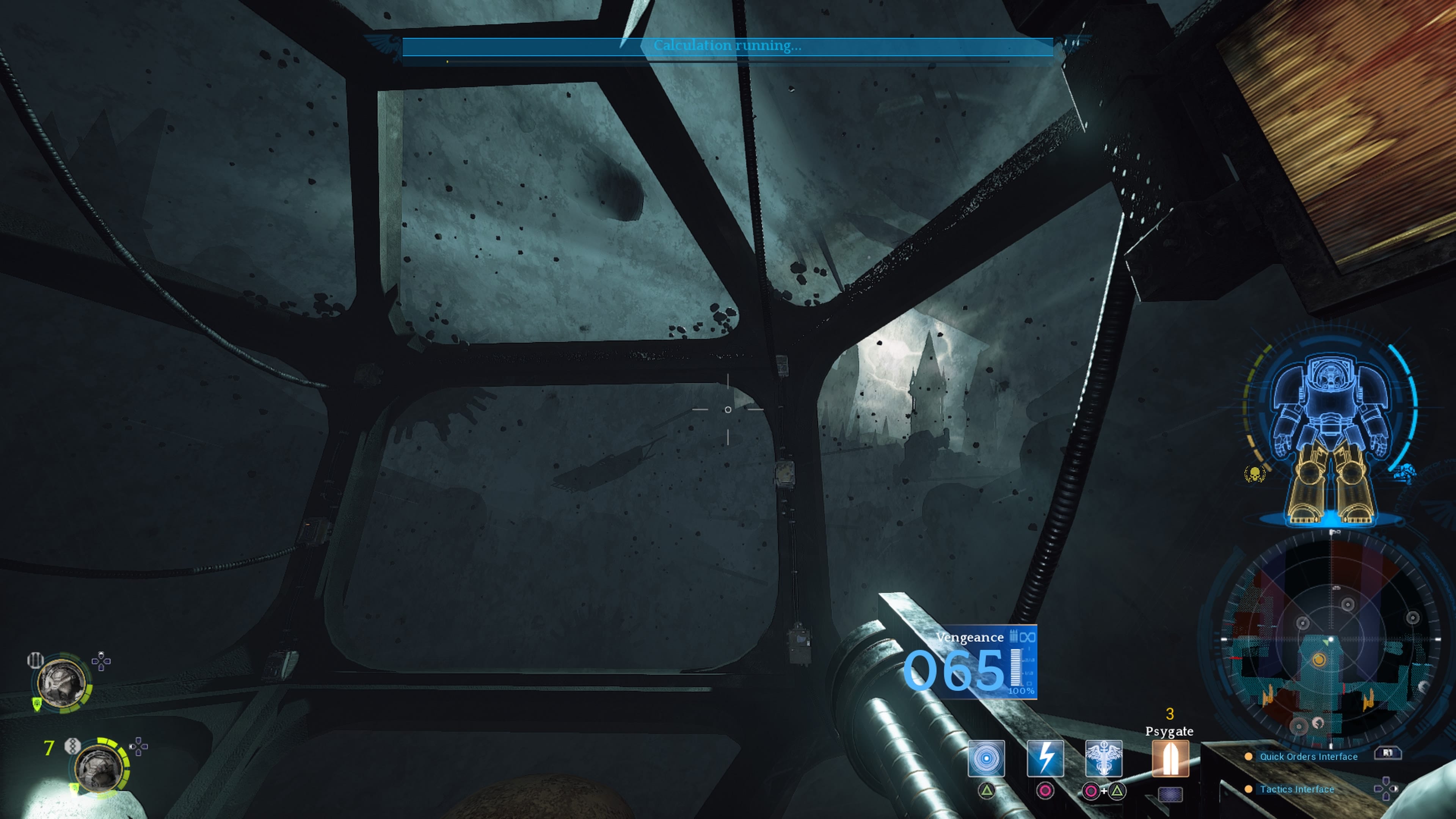
Why do we care about Space Hulks? A), because they’re a source of valuable lost artifacts; and B), because they tend to be infested with monsters and ne’er do wells, especially Genestealers, which have to be dealt with.
What is a Genestealer? A Genestealer is a legally distinct xenomorph, and a specialised sub-species of the Tyranid species3. They’re big, fast, strong, and come in a variety of sub-types, including humanoid variants capable of using weapons and psychic powers.
Who are ‘we’? Why, we are Space Marine veterans, clad in Terminator power armour. We are big lads, we are fanatically devoted to the Imperium, and we have important work to do.
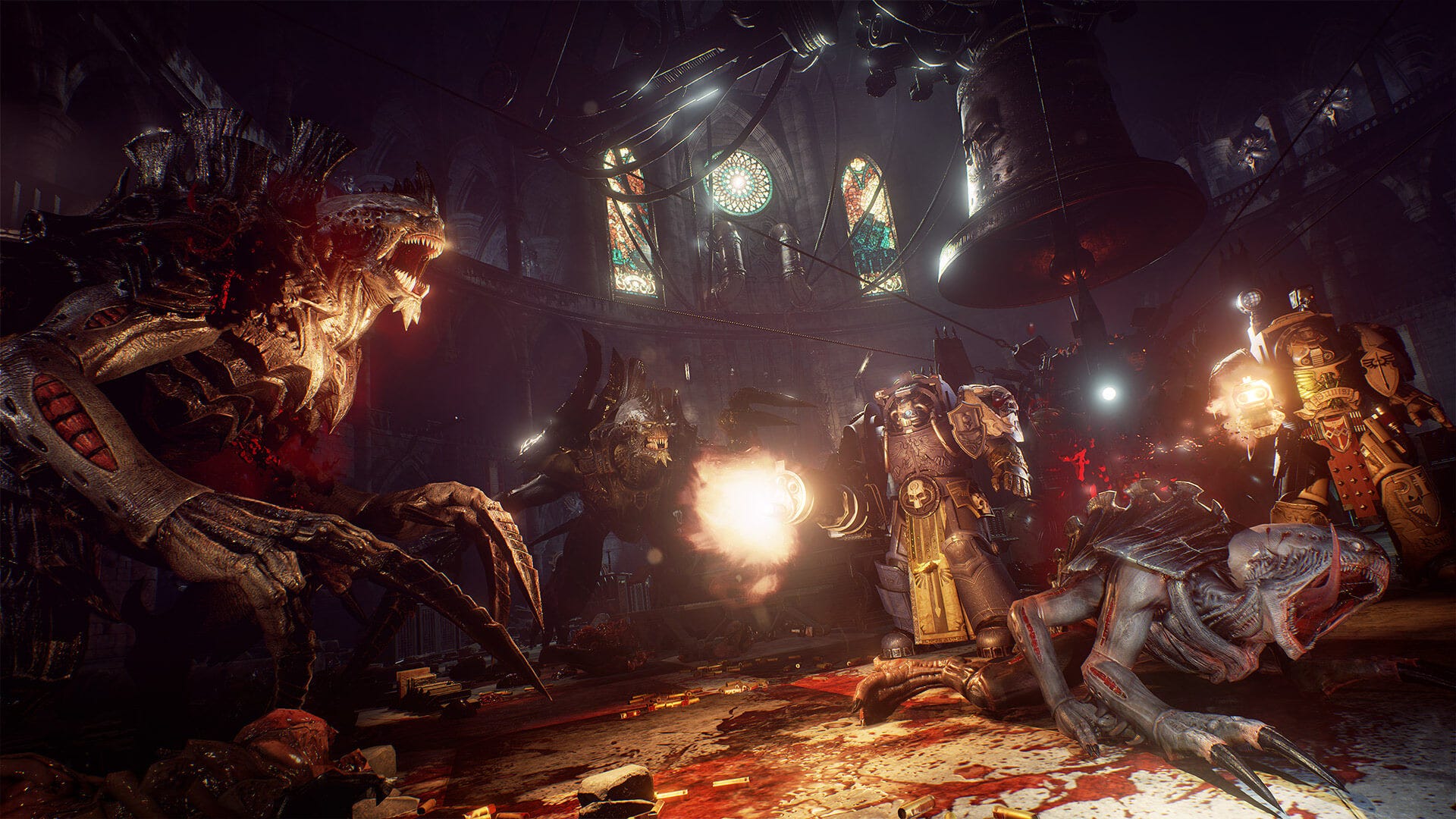
Is this another bug hunt? Yes, absolutely.
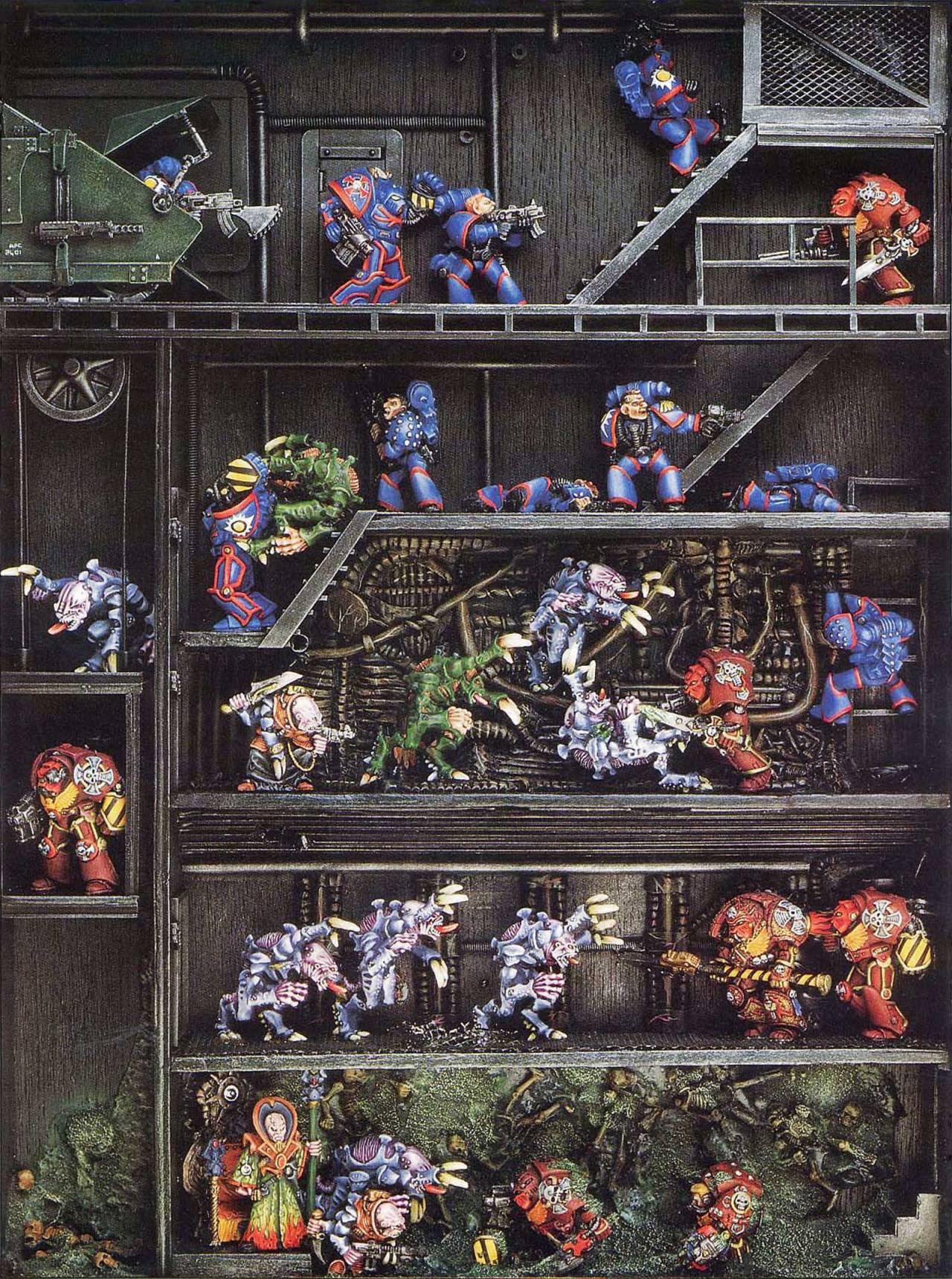
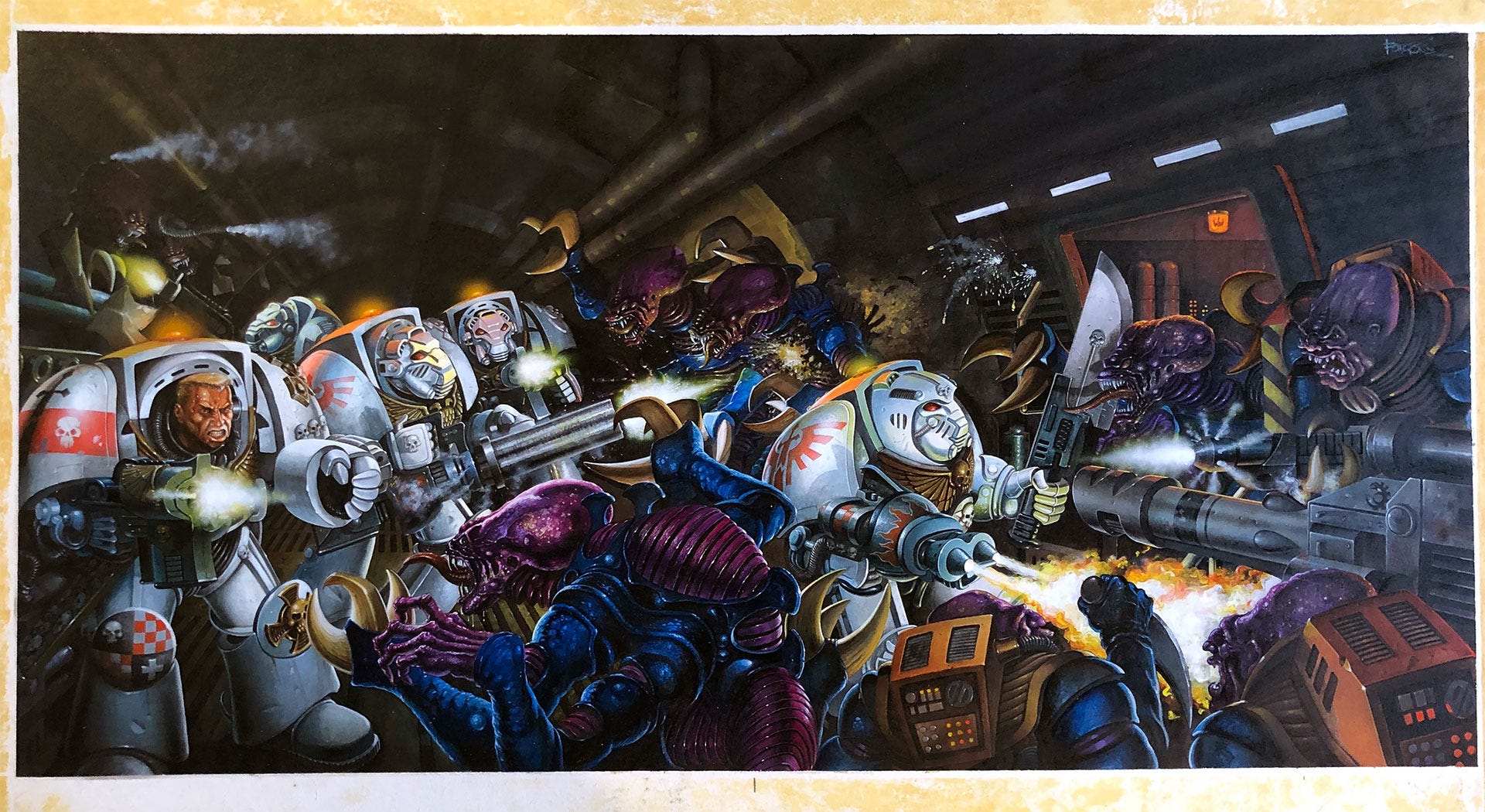
In the original Space Hulk board game, one player controls a squad of Space Marines, while the other controls the Genestealers. These two forces battle it out in narrow hallways, which can only be traversed in single file. It’s a game about dark corners, ambushes, careful coordination, and treacherous dice rolls. Space Marines may be the elite of the Imperium, but when they board a Space Hulk, there’s no guarantee any of them are getting out alive.
The Deathwing experience
Space Hulk: Deathwing stays very true to these roots. The game puts the player in the shoes of a Space Marine librarian, a powerful psyker4 who commands a three-man squad searching the depths of a Space Hulk named Olethros.
The first thing to be said about Deathwing, which is pretty much universally acknowledged, even by those who disliked the game, is that it is incredibly atmospheric. Each level is designed with an intricacy, fidelity, and artistic vision seldom matched in 40K’s video game adaptations. The game’s assets, particularly in-game papers, ephemera, and set-dressing, are very high resolution and detailed, and the use of light and shadow throughout the game creates a wonderfully oppressive, brooding atmosphere.
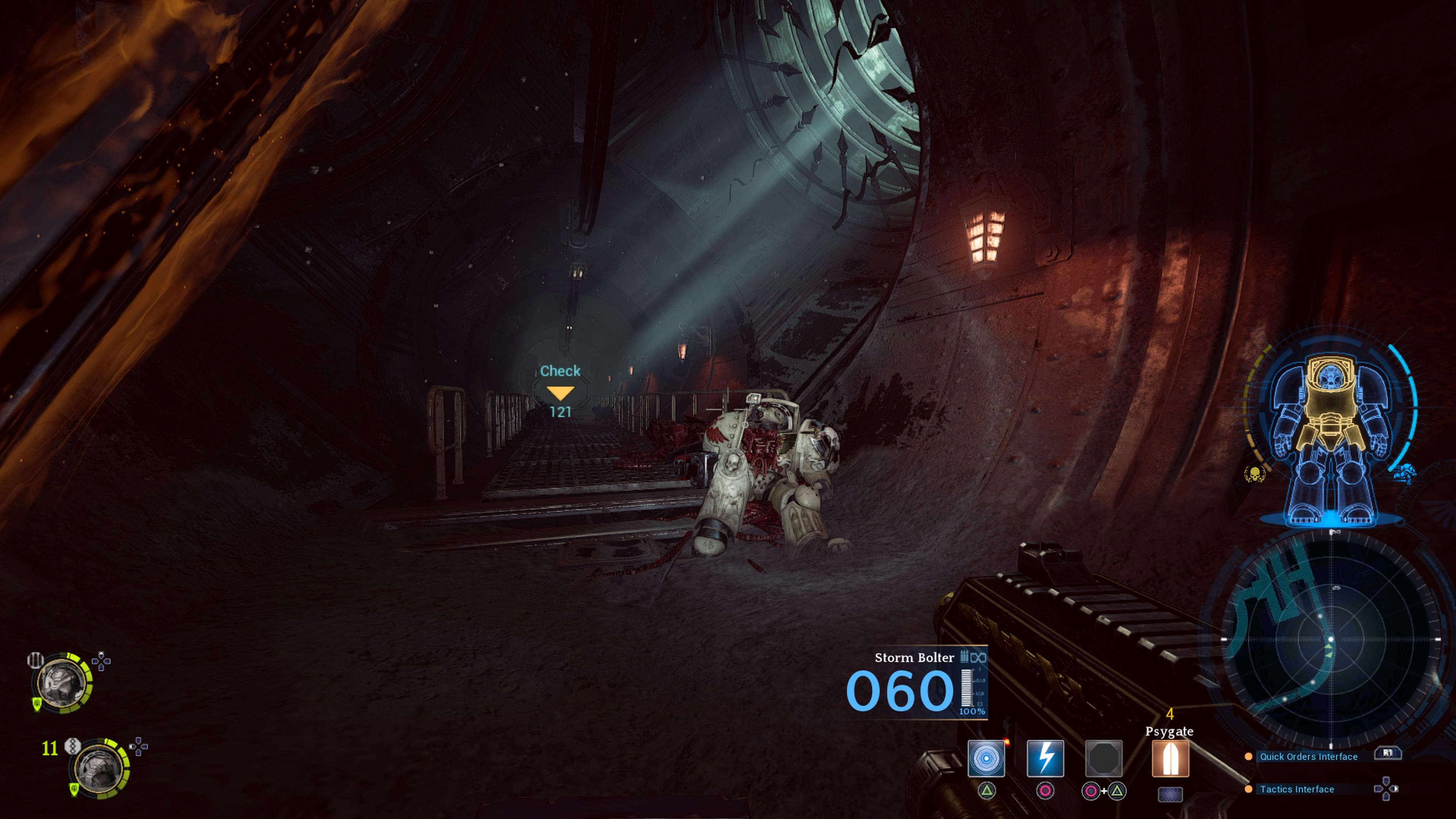
It’s also noteable that each of the game’s levels has a completely different aesthetic identity and feeling, reflecting the diverse histories of the various derelicts the Marines traverse. Adeptus Mechanicus ships blend industrial aesthetics with lofty stone chapels and prayer halls, with a lot of red lighting, evocative of the red robes of their long-dead masters. An ill-fated Black Templar ship boasts a gigantic cathedral, where stained glass windows shed light on the tombs of fallen crusaders. A Rogue Trader’s galleon bears grisly mementoes of a crew driven to cannibalism, while the hidden dungeons and torture chambers aboard a Dark Angel warship hint at the Chapter’s terrible secrets.
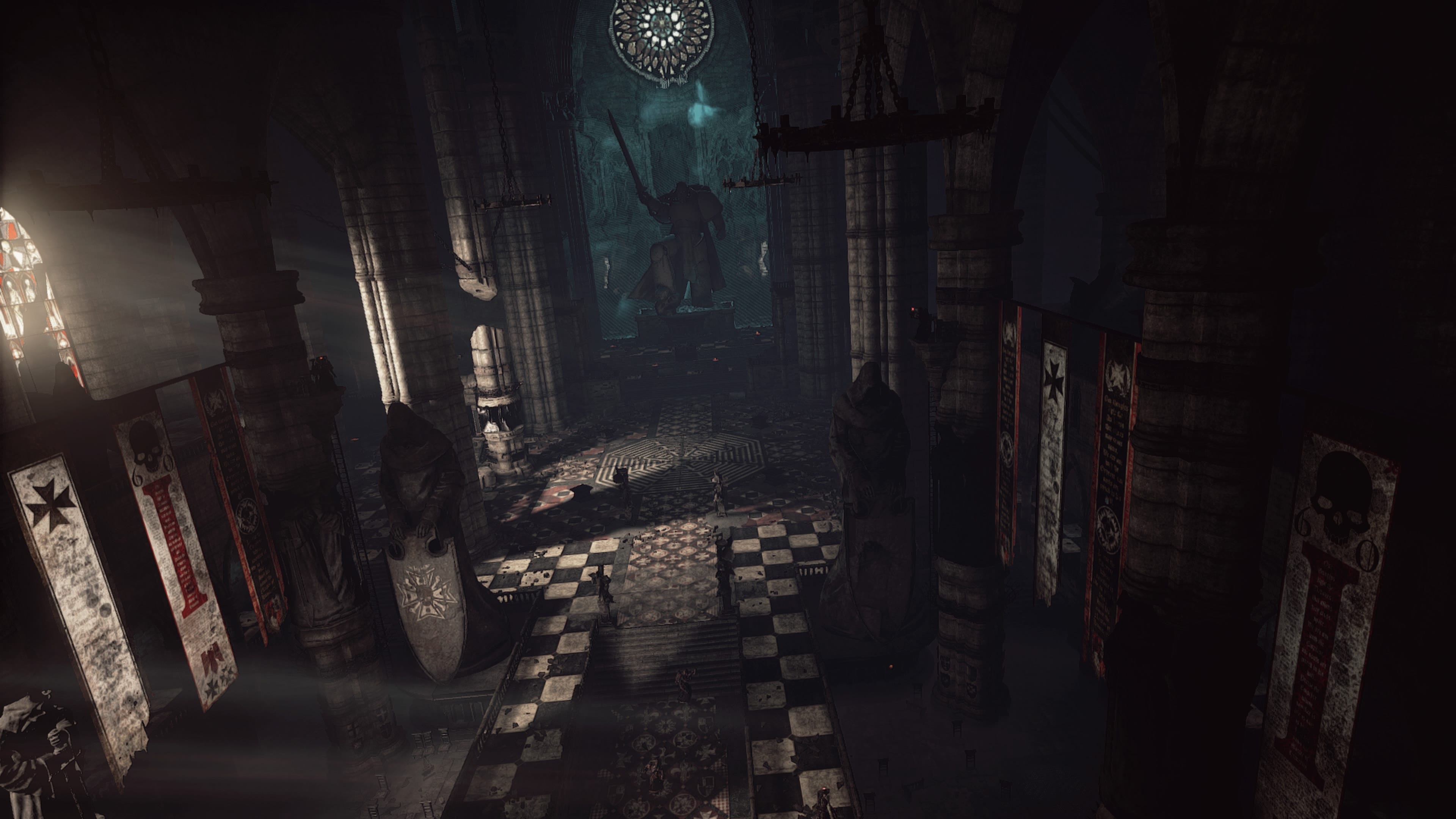
Given the aesthetic strength of Deathwing, it is no surprise that the developer, Streum On Studio, would go on to make a second 40K game, Necromunda: Hired Gun (2021), which deserves a separate post. Streum On’s prior pedigree is also worth mentioning, as they had previously developed E.Y.E.: Divine Cybermancy (2011), an avante garde cyberpunk ARPG, with the same anachronistic flare as Deathwing and Hired Gun.
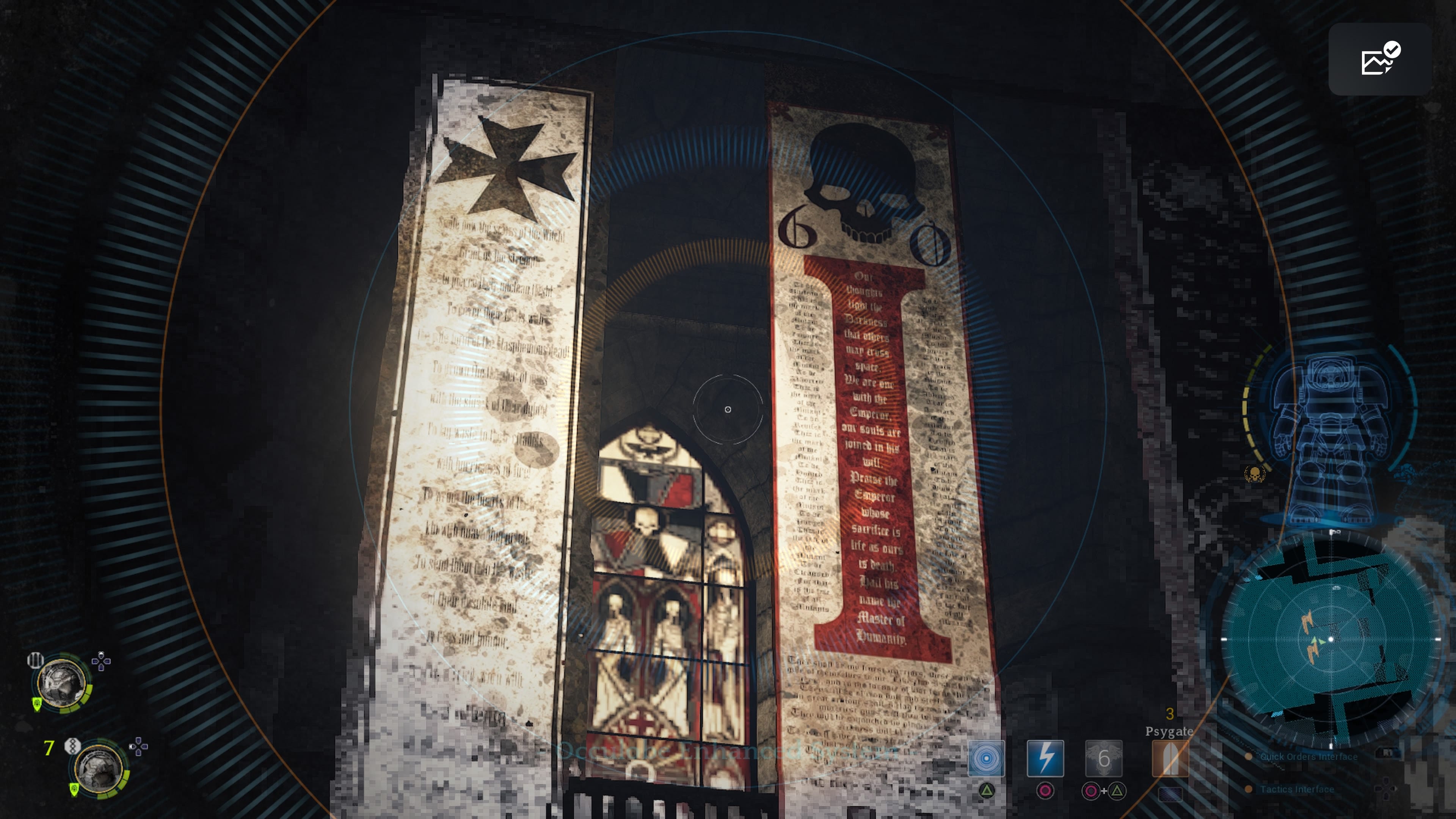
As for the actual gameplay of Deathwing, it could be described as an acquired taste, feeling awkward, restrictive and finicky, with several early spikes in difficulty, but this awkwardness is not necessarily a bug, but a feature, in that it actually complements many key design features.
In Deathwing, the Space Marine heroes are defined not so much by their superhuman qualities, as in the more populist Space Marine 2, but rather by their vulnerabilities and limitations. Clad in cumbersome suits of armour, our hero and his squadmates are slow, ponderous, often exposed, and always outnumbered. They can only run in short bursts, have many blind spots, and even at full strength may be overwhelmed in moments if surprised by certain enemies. The first person perspective, combined with the often narrow spaces, creates a stifling, claustrophobic effect, and the relative awkwardness of the UI actually contributes to the intended sense of threat, to the point that what may or may not be clumsy implementation actually begins to resemble clever design.
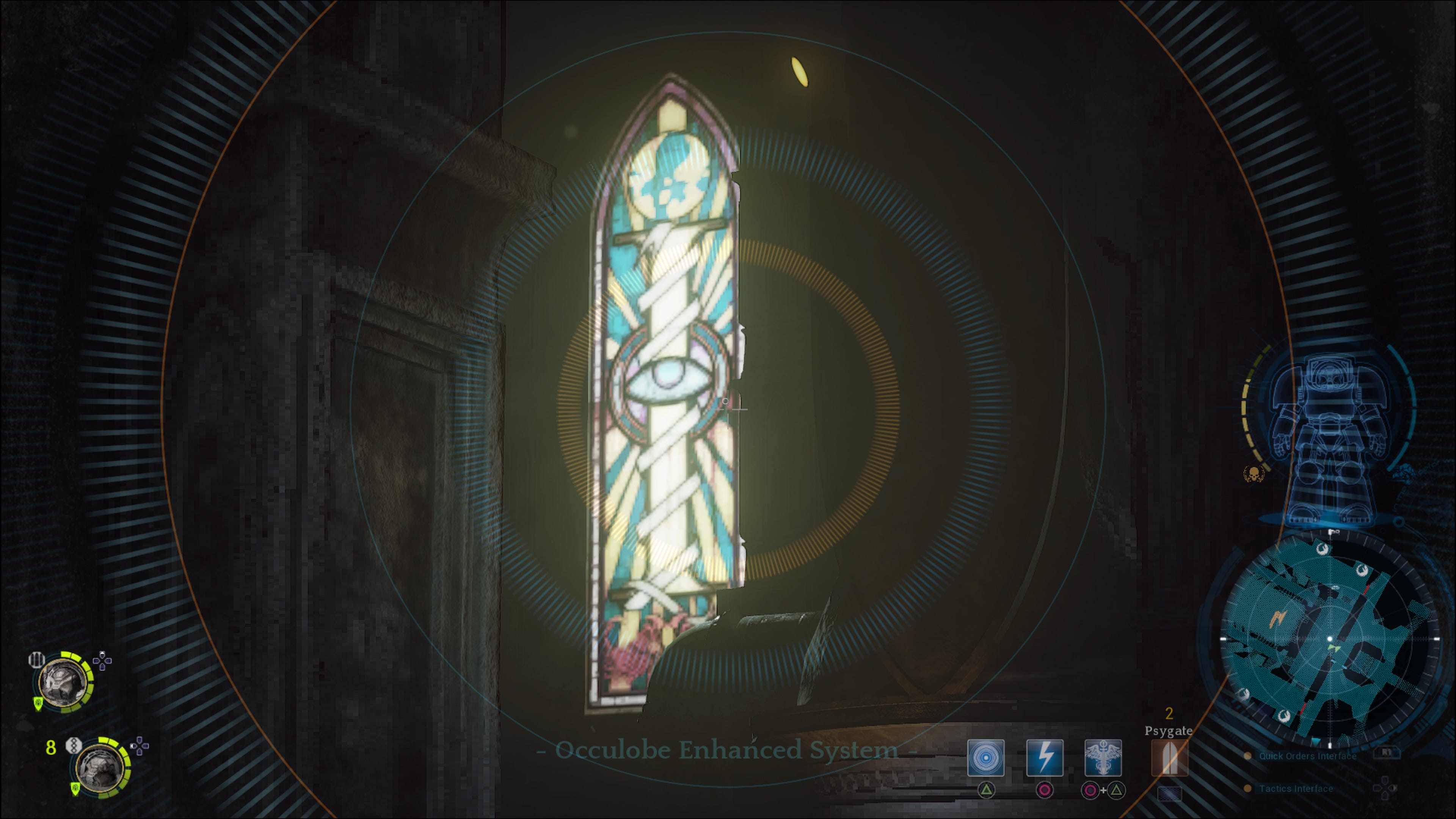
For example, one of the few advantages the player has over the Genestealers is the ability to look at the in-game maps and plan a route to the next objective, through complicated levels which are not linear, and typically offer multiple paths forward. By careful planning, it’s possible to avoid open spaces where the aliens’ numbers work in their favour, anticipate hazards such as security turrets, and to figure out the locations of doors, which can then be strategically sealed to impede the aliens. However, opening the map does not pause the game, nor does hacking turrets, which creates a sense of pressure and a need to time map consultations carefully, to avoid being caught off guard and mobbed while you’re planning your next move.
To make matters worse, the default button to open doors is the same button used to seal them (!!!), which means that it’s entirely possible to accidentally open a door and let in a swarm of Genestealers when you meant to lock it. This may seem unfair, but in the context of a setting where technical knowledge is the privilege of a special priesthood, it’s entirely possible that a keyed-up Space Marine would fumble a control panel with disastrous results. Likewise, the sometimes awkward radial for issuing commands to squadmates actually offers an effective simulation of the difficulty of soldiers communicating under fire.5
As such, the game’s foibles (if they are foibles) actually end up enhancing the experience, by increasing the tension and sense of danger that Deathwing uses to such great effect, and making the player feel vulnerable. Even the lack of a typical soundtrack, which is almost unheard of (no pun intended) in modern gaming6, contributes to the sense of menace. Deathwing’s sounds are the stacatto of gunfire, the protests of damaged armour, the howls of approaching beasts, and the terse jargon of soldiers under pressure.
A horror in shooter’s clothing?
In many ways, it may be better to compare Deathwing to games in the survival horror genre than to other first-person shooters. Like a survival horror game,7 the emphasis is always on imposing limitations while putting pressure on the player, making movement slow and tortuous as if in a nightmare, narrowing the player’s field of vision to make the dark corners darker, and making interactions with the environment deliberately awkward, so as to maximise the time in which the player is vulnerable to attack.
The Amnesia series is a perfect specimen of this - Amnesia famously makes the player manipulate objects directly via mouse/controller, rather than simply pressing a button and having the action completed automatically as in most games. The genius of this is revealed when the player is under pressure, such as when the object you’re fumbling with is a bolted door, and there’s a monster two steps behind you. Alien: Isolation8 followed this formula very closely, to great success, making the player complete noisy and finicky interactions with machinery out in the open, knowing that the alien could descend at any moment. The similarities to Deathwing are obvious.
Deathwing also borrows from the survival horror formula by limiting the effectiveness of the player’s weapons in a big way. Every weapon has its drawbacks - few are accurate except at very close range, and many suffer from issues such as overheating and jamming, the latter being particularly worrisome because it can happen unpredictably at any time. Resources such as healing charges and teleport beacons9 are also very finite, and must be carefully rationed and used sparingly over the campaign.
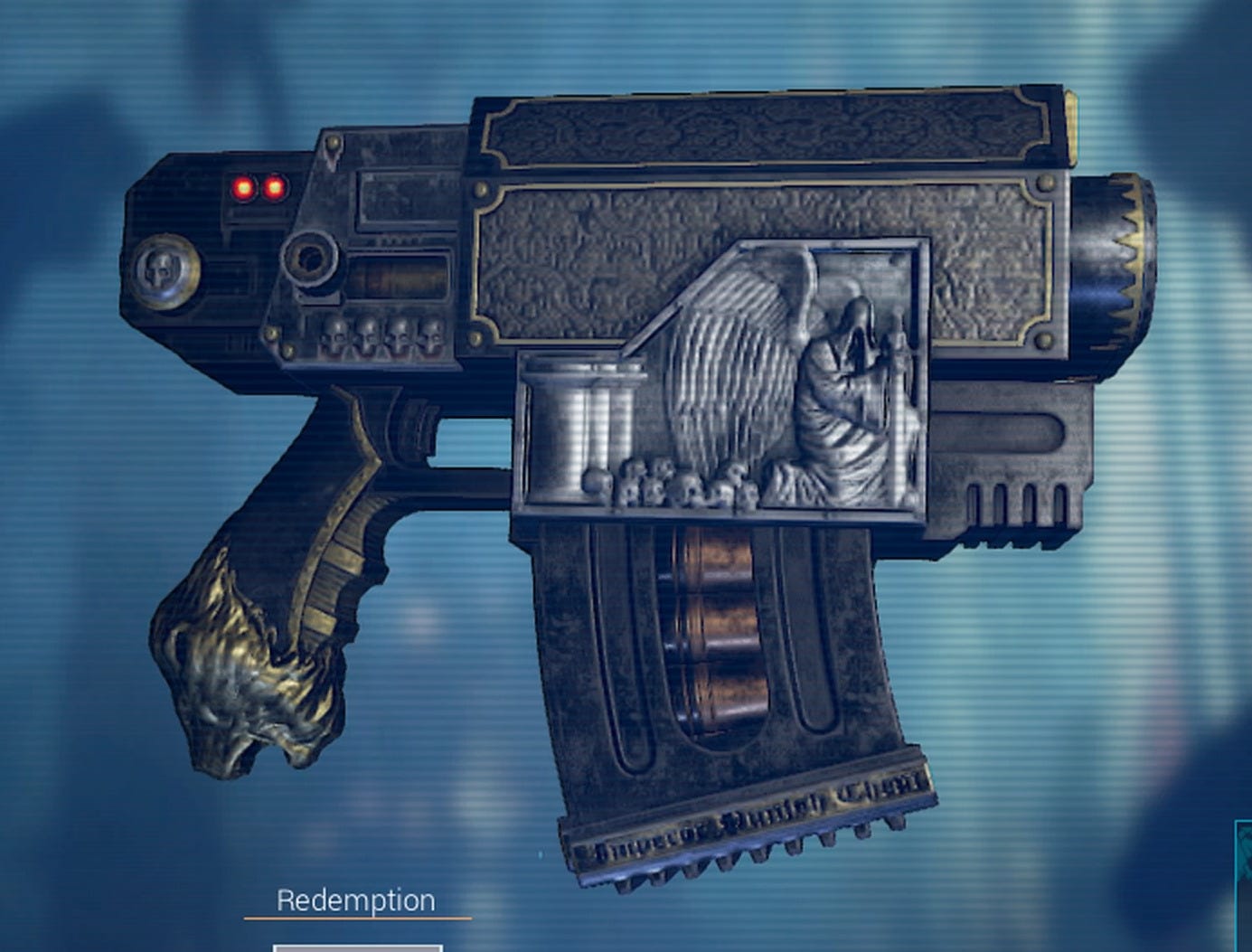
In short, Deathwing does everything it can to make the player feel vulnerable and on edge, and it does it very well. It forces you to plan ahead, think tactically, and use resources and the environment to your advantage. It’s all very much in the spirit of the original board game, despite the more action-oriented format, and also in tune with its links to Alien.
Addressing criticisms
The story of Deathwing is one of the features that video game critics did not like at release. To quote one:
Sometimes you stomp through duct systems and cramped reactor cores, and sometimes you let rip in massive stone cathedrals erected to the decrepit god-emperor of humanity . . . But all this atmosphere is nothing without context. The game dumps you in the thick of it, with a minimum of exposition. This isn't always a bad thing, but in Deathwing players are bombarded with references that must be absolutely baffling for anyone without a childhood spent poring through Games Workshop codices.
For a start, I would dispute the idea that Deathwing’s sparing exposition is a weakness. On the contrary, it’s a pleasant antidote to the countless modern games following the Ubisoft/Rockstar/CD Projekt Red/Naughty Dog formula10, which model themselves after TV dramas in terms of format and (lack of) interactivity, never considering that if someone wanted to watch TV they wouldn’t be playing a game. In Deathwing, the player’s desire to play is respected: context comes in the form of a few short cutscenes, voiced briefings, and the odd chat between squadmates, as well as some texts scattered around the various wrecked ships (which you are under no obligation to read).
As for the idea that the game is too dense in terms of lore, I’m not sure I agree either. It’s true that proper nouns aren’t always defined unless strictly necessary, yet in a game so light on dialogue, it is a gross exaggeration to say that the player is ‘bombarded’ with anything. Admittedly, I am coming at it with the benefit of a childhood (/young adulthood) spent poring over Games Workshop codices, so my perspective is different. Even so, I can’t help but think that, in this terrible wonderful age of technology, you could always pause the game and Google anything that you were confused about, if you so wished. And if you didn’t so wish, you have the good fortune to be playing an action (/horror?) game, in which you do not by any means need an intricate grasp of the big picture from moment to moment, if at all.
I would also argue that the emotional sparseness of Deathwing’s story is actually a great benefit. It contributes to the forbidding atmosphere, while also conveying key ideas of the setting. I have written before about dehumanisation as a core theme of 40K, and Deathwing is remarkable for its distinct lack of humanity. The only living, unobscured human face we see in the entire game is the distorted image of the commander in the briefing screen; other than that, there are only statues, the dead, and the librarian protagonist’s face, which is obscured almost entirely by a respirator and cybernetic implants. His brothers in arms never remove their helmets at all: these warriors are totally buried in their social roles, and their faces do not matter.
Helmets and masks in 40K have a long history, partly because they’re more fun to design and easier to paint (in the context of miniatures) than human faces, but more interestingly because they emphasise uniformity and loss of individuality, key themes in the militaristic societies that dominate this universe.11
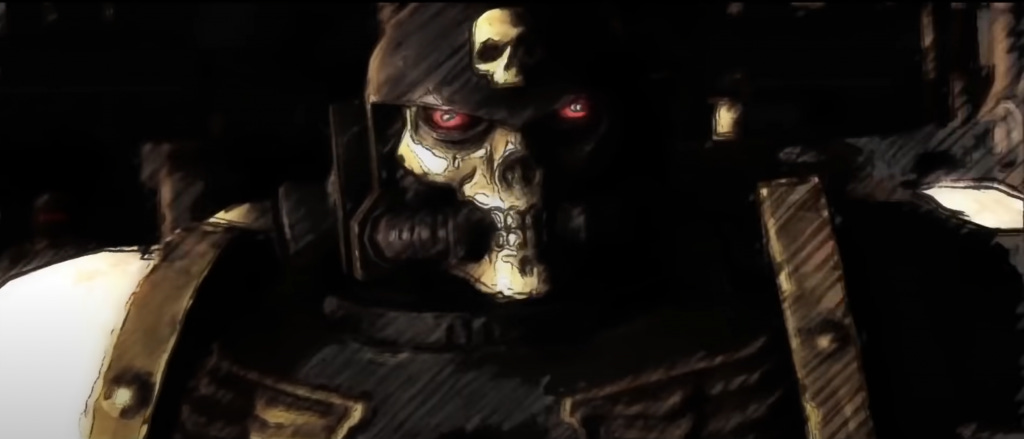
In Deathwing, loss of humanity and individuality are key - our librarian protagonist is not on a hero’s journey, nor does he learn anything or grow as a person. He is just a soldier grimly trudging down the narrow path of duty, the claustrophobic passages of the hulk reflecting the strictures that define his life. This claustrophobia-as-metaphor-for-oppression is brought out very clearly during one of his psychic visions, a short but memorable interlude in which the player advances alone down a series of narrow tunnels, bludgeoning endless waves of opposing aliens. Here, the walls are painted with an ominous circular mantra, which can only be read in terms of oppression and lack of meaning:
What is your duty? To serve the Emperor’s will. What is the Emperor’s will? That we fight and die. What is death? It is our duty. What is your duty?…
For our librarian to somehow find a deeper meaning, therefore, would kind of defeat the point. As well as claustrophobia-as-oppression, the game also employs the characteristic agoraphobia of 40K, touched on before: the player often feels dwarfed by the cavernous spaces and monstrous machines12 within the Space Hulk, which make us feel small, exposed and insignificant, even though we are seeing through the eyes of towering super-soldiers.13 This feeling of smallness is much in keeping with these words from the setting’s iconic opening text:
To be a man in such times is to be one amongst untold billions.
It’s also worth noting that our grimly dutiful librarian is the least talkative of the three squadmates, speaking mainly in loading screen narrations14. His companions, gunner Barachiel and apothecary Nahum, are chattier, and well-characterised, though never intrusively so - Barachiel is impetuous and preoccupied with death and glory, whereas Nahum is cool-headed and sardonic, as befits a medic. But ultimately, no-one here is trying to emulate The Last of Us, nor would it be appropriate if they were.
Another dissatisfied contemporary review seems to have echoed the previous:
The glorious moments of fervent xeno-purging are too fleeting, and often left me standing in dark corridors, surrounded by my slain foes, looking for any kind of context or sense of lasting accomplishment . . .
Again, we see the same preoccupation with ‘context’. This seems to have been the critical term du jour, against which all games were measured irrespective of genre, setting or tone. I found this critic’s phrasing interesting, however, because it reminded me of Trip Harrison’s excellent recent piece on Hotline Miami (another game preoccupied with the symbolism of masks…), which described a similar feeling but in a positive sense. He recounted how Hotline Miami’s frenetic violence is always followed by moments of eerie clarity, in which the protagonist is suddenly alone with the broken bodies of his victims, and must backtrack through the carnage while walking to his car. In the context of the game’s story, which is more suggested than delivered directly, this clarity represents a comedown and harsh return to reality for the protagonist, a hitman who uses drugs to take the edge off.
Similarly, I would say that the coldness of Deathwing, the distinct lack of any emotive ‘context’ when the smoke clears is sort of the point - after all, in the grim darkness of the far future, there is only war, and violence, with or without meaning, is pretty much what defines the lives of Space Marines like our librarian. This is a universe of endless, thankless toil, where accomplishment is always fleeting, and life is generally nasty, brutish, and short. Not for nothing is the saying ‘Only in death does duty end’ a motto of the Imperium.15
That’s not to say that 40K by definition cannot offer involving, emotional human stories - Helsreach is a well-known example to the contrary, as is Owlcat’s excellent Rogue Trader video game - yet Deathwing is a fairly short action game about killing aliens on a dangerous derelict, not a lengthy novel (/fan-made film) like Helsreach, nor a 100+ hour RPG like RT16. To demand that a short 40K action game be something other than a short 40K action game is, in my view, not a fair basis for criticism.
It’s also worth noting that the more recent Necromunda: Hired Gun, Deathwing’s not-sequel from the same developer, likewise chose to forego typical emotive stakes, and was also predictably criticised for breaking this convention. Again, though, there was a point there - Hired Gun is about a cutthroat cyborg killing gangsters in an industrial hellscape. It was never going to be an uplifting, life-affirming story about found family (or whatever critics are into these days), nor need it have been.
Closing thoughts
To get the most out of Space Hulk: Deathwing, it’s necessary to have a clear idea about what it is, and what it is not. Is it a fast-paced, frenetic FPS, like the Doom reboots? Not really, no. Is it an emotional journey resembling prestige TV, like The Last of Us? Absolutely not. Is it a slow, tense, atmospheric dungeon crawl, the gloomy beauty of which will haunt you for many months? Now we’re getting warmer.
Deathwing is better understood as a quasi-survival horror game, in line with its board game roots and Alien ancestry, than as a typical shooter, and better assessed as a glimpse into the long, gruelling service of a Space Marine than as a typical story exploring a turning point in a person’s life.
This is not a turning point for our librarian - it is a Tuesday afternoon, albeit a particularly rainy one.
In 1993, 1995, 2013, 2014, 2016, and 2018. Next Space Hulk when?
Full context: this is a universe where spacecraft (called voidships) are gigantic, cathedral-like structures, crewed by thousands or even tens of thousands of people, who are usually organised into clans with hereditary skills and duties, bound in feudal servitude to their ship’s master. These voidships travel incredible distances by passing through the Warp, a chaotic psychic realm also known as the Sea of Souls. Space Hulks phase in and out of the Warp, and reappear in realspace unpredictably. If voidships sound incredibly sexy, cool and aesthetically appealing from this description, play Rogue Trader immediately.
Per modern canon. In 40K’s earliest iterations, genestealers were a totally separate species, unrelated to Tyranids. For many years now they have been a Tyranid infiltrator caste, who can turn humans into hybrid cultists.
Psykers being humans with psychic powers. The wizards of 40K.
Rebekah King recently devised a very useful term, ‘metatextual boredom.’ This is when an author makes the reader feel bored on purpose, so that they share a character’s sense of restlessness and frustration in a scene. Similarly, the sense of frustration and tension generated by Deathwing’s interface can actually be a good thing, because you share the emotions of a protagonist under pressure.
With recent titles, even From Software has bowed to the norm of having a constant ambient soundtrack, whereas the Souls games and Bloodborne benefited hugely from their eerily quiet environments, in which the noises of monsters were all the more unsettling, and the player felt grounded in a ‘real’ setting.
Which may be action-oriented and still be classed as such, e.g. Resident Evil 4.
A blood relative of Deathwing, through the connection of Genestealers to xenomorphs.
Which allow the player to save the game, revive fallen squadmates, change weapons, and refresh healing charges at the bridgehead.
To be clear, I don’t hate all of the big games produced by these companies, but how enjoyable they are depends entirely on how much freedom they provide - The Witcher 3 balances its linear and dialogue-heavy main quest by offering a huge and beautiful world with plenty of monsters to slay and treasures to find, so you can take regular sabbaticals from the plot when you just want to play. The same cannot be said of The Last of Us, which is literally just a TV series where you press buttons.
See also: bald heads. We see a lot of baldness in 40K, and again, it’s easier to sculpt and paint, but also implies strict military order and enforced conformity.
Sometimes with the withered bodies of servitors (cyborg slaves) wired in. It’s a metaphor for how the industrial revolution and its consequences have been a disaster for the human race, in case you were wondering.
I am reminded somewhat of a cool interview last year from the designers of the new Spyre Hunters from Necromunda. Spyre Hunters are nobles who undergo painful and deforming surgeries in order to fit into alien battle suits, and the designers talked about their wish to emphasise that this was a world where even the lives of society’s elite are full of hardship and suffering, their bodies mutilated to fulfill their social roles. In a similar way, the vast and hostile spaces of Deathwing and Space Marine 2 emphasise that even the superhuman Space Marines are small, vulnerable, and powerless in the grand scheme of things.
He is voiced by Toby Longworth, English actor and prolific reader of 40K audiobooks.
And even then, maybe not - ‘Even in death, I still serve,’ rumble the Space Marine dreadnoughts, walking sarcophagi in robot bodies. See also the Sicarians, resurrected cyborg soldiers of the Adeptus Mechanicus.
(which has enough text for a whole series of novels, and is heavily character-focused)
I made an account on here specifically to thank you for creating a great review for a game that has a lot of meaning to me. It's what started my interest and ongoing obsession with the 40k universe which inadvertently had impact on my personality and outlook on life. I did not know anything about 40k prior to playing Deathwing but I knew something about it was different.
Your other reviews seem interesting. I'll jump onto those. Thanks again.
Fiiiiine, I'll finally download Deathwing.
Did you ever play it co-op? One of the reasons I stalled on actually playing it was so many reviews insisting it was designed for co-op and the AI wasn't good enough to assist you, but I don't really do a lot of co-op anyway.