

The Narcissism and Nihilism of Neil Gaiman
On the fall of a fantasy giant, and the red flags that everybody missed.

Content Warning: Sexual abuse (obviously).
Note that this article is based on the assumption that the allegations are true, a) because I believe them, b) because it’s tiring and flow-breaking to insert ‘allegedly’ before every detail and comment.
To regular readers - I will be returning to less heavy topics soon. Unfortunately, however, Gaiman has angered me, shortly after Sapkowski angered me, and whereas Sapkowski is (I hope) only guilty of tasteless prose, Gaiman is by all appearances an actual monster. I feel it’d be remiss not to comment, given that said monster has grown fat off the fantasy genre for decades. I also have a few (hopefully) original observations that I felt were worth sharing, particularly re. the nature of his personality, the hints in his work, and the role of his nihilistic attitude.
Neil Gaiman has, for many years, been something of a media fixture, to the point that pretty much everyone in the Anglosphere and beyond knows his face, voice and (insufferable) style of dress. I know relatively little about him, having never taken an interest in his work,1 yet he’s been so successful at insinuating himself everywhere that he’s a familiar face even to me. As you can probably tell by my choice of words, I never liked him very much - he always seemed smarmy and a bit of a poseur at best, and his too-cultivated progressive nice guy image set off alarm bells in my (admittedly overactive) hindbrain.
I like him even less now, in light of Lila Shapiro’s Vulture article, which is unfortunately paywalled.2 It went places I did not expect - it seems that Gaiman is unusually depraved, even as sex offenders go. The abuse described by Shapiro is so cruel and disgusting that it’s the kind of thing you usually only come across if you read about serial killers. I will not go into too much detail here: it’s enough to say that he enjoys degrading women, and also (according to two different sources) seems to enjoy doing so in front of his young son. He also seems very adept at picking victims who are vulnerable psychologically, financially, or both, which in practical terms means that they are overwhelmingly likely to settle in court (if it ever gets that far, which it probably won’t) and he won’t spend a day in prison unless they actually start finding corpses in his garden.3 Sadly, the only penalty Gaiman is likely to face is public censure, which for a needy personality like his might actually be somewhat meaningful, and is more likely to impact his actual lifestyle than the associated loss of income.
My overwhelming impression of Gaiman is that he has been pretty much hiding in plain sight for his entire career, because when you look at his personality, he is 100% the type of person you would expect to be a serial abuser. A quote from the documentary Neil Gaiman: Dream Dangerously (2016) seems very illustrative of this:
When I was young, I had unbelievable chutzpah. The kind of monstrous self-certainty that you only get normally in people who then go on to conquer half the civilized world.
This quote appears in Shapiro’s piece,4 and I cannot describe how hard I cringed when I read it. Imagine actually saying this about yourself. You probably can’t, because you’re probably somewhat normal, and not a raging narcissist. Imagine even being in the same room as a man who puts himself in the same category as Alexander the Great, and is prepared to be recorded saying so. Would you want to stay in that room? More to the point, would you be entirely surprised if a man who says these kinds of things about himself turned out to be a degenerate who wants women to call him ‘master’ and drink his piss?
For comparison, here is a famous quote from Napoleon, a man not traditionally associated with humility:
I saw the way to achieve all my dreams. . . . I would found a religion, I saw myself marching on the way to Asia, mounted on an elephant, a turban on my head, and in my hand a new Koran that I would have composed to suit my needs. In my enterprises I would have combined the experiences of the two worlds, exploiting the realm of all history for my own profit.
In this quote, Napoleon is reflecting about the megalomaniacal dreams he had of conquering Egypt as a young man. It actually looks a lot more humble, self-aware and self-deprecating in context, because Napoleon failed miserably in Egypt, and is here describing (with the benefit of hindsight) how absurd and unrealistic his ambitions actually were. Here, we see the value of failure: Napoleon became a wiser man through disappointment; Gaiman’s early success made him into a monster.
Before going further, I should clarify here that, in pointing out how in-plain-sight Gaiman’s malignance was, I do not in any way mean to blame the victims, or imply that they should have known better. As mentioned above, he was very good at picking people who were psychologically fragile, financially desperate, or both.5 The worst case (that we know about6) concerns a 22 year old student who had been homeless at fifteen, who had no job or money, who had been sexually abused before, and whose parents were not in her life when she was abused by Gaiman. Another long-running abusive relationship was with an employee who lived on his property and was completely dependent on his money and goodwill in the aftermath of a divorce. I do not in any way blame these individuals for being exploited. But it’s hard not to feel some indignation towards the entertainment industry and even towards society, i.e. people in general,7 for praising, rewarding and aggrandising this morbid personality to the extent that they did. Of course, that’s easy to say now that the truth is more or less out in the open.
Still, certain aspects of his work seem very indicative of the type of person that Gaiman is (and always has been). Shapiro details a character in Gaiman’s Sandman comics, a writer who becomes famous while sexually abusing a captive muse, all the while telling the world that he considers himself a ‘feminist author’ (just as Gaiman does8). This now looks suspiciously autobiographical, although at the time no-one took special note of this monster-of-the-week villain. Stardust, which is pretty much the one Gaiman film I have seen (not on my own initiative), also took a bit of a turn with its unexpected threat of gang-rape in an incident aboard a pirate ship. This seemed very strange and jarring to me at the time, given how light and fairy tale the rest of the film was,9 but in context it makes more sense than it did then. A rapist is going to be a person who thinks about rape a lot, even in the context of a clean and cutesy fairy tale narrative more suitable for children than grown-ups.
I’m not intimately familiar with Good Omens,10 but Youtube has thrown enough clips my way for me to get the gist. The premise of Good Omens is that heaven and hell exist, but are desperately mundane corporate bureaucracies, with absolutely nothing mysterious, divine or meaningful about them - this is the basis of pretty much every Good Omens joke. In short, Good Omens appears to have been conceived by a man who doesn’t believe in (or attach any importance to) good or evil, and who sees no purpose in the universe, only endless mundane politics and hierarchies.11 Is it totally surprising that such a man has a fixation on power dynamics, has a weird satanic tone to his non-consensual roleplay,12 and clearly rejects the idea that there’s anything sacred in his fellow human beings?
Not to go too hard on the religiosity (which would be more than usually weird behaviour from me, given that I am not religious), but I couldn’t help but connect what I read in Shapiro’s article to the cutesy cynicism of Good Omens. As for the satanic element in Gaiman’s makeup, I was reminded of Father Merrin’s famous line from The Exorcist, in which he explains the demon’s use of sexuality to terrorise its victims:
I think the point is to make us despair. To see ourselves as... animal and ugly. To make us reject the possibility that God could love us.
(I think of this quote very often in relation to modern entertainment, but that’s a whole other can of worms, which I shan’t be opening any time soon.)
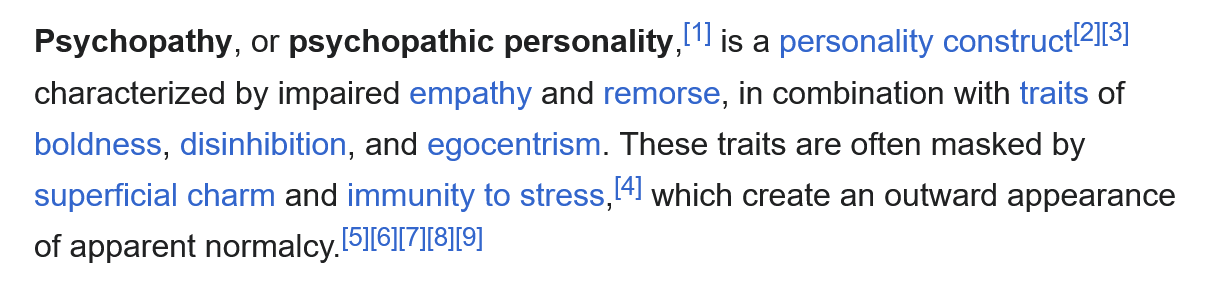
Gaiman’s power-centric worldview is also very well-described in Shapiro’s article, which details his history with the Church of Scientology,13 as well as the affable ease with which he seduced his fans and attached himself to big-name genre authors. The unusual degree of ease with which Gaiman seems to navigate social situations and ingratiate himself with all the right people is a trait strongly associated with psychopathy, a description that pretty much matches Shapiro’s characterisation of Gaiman.14
Gaiman is also evidently a deeply inauthentic person - one woman’s account in Shapiro’s article describes how quickly he could flip between addressing her as an individual, to running a pre-conceived script that obviously had nothing to do with her. I’d suggest that this inauthenticity was always evident in his trademark suit and black t-shirt combination, which has been a core feature of his unchanging media image for upwards of twenty years; you’d be hard-pressed to find a picture of him without it. Isn’t there something a bit creepy about someone with such an unchanging, deliberately curated, artificial image? He is creepy in the way that influencers are creepy, and was something of a forerunner to that archetype, marketing his writing via image, personality and penchant for networking.15 Even his voice is apparently a construct, the product of elocution lessons. Shapiro notes that:
In America, people mistakenly assumed he was an English gentleman.
This seems to be precisely what he has always wanted to be, evidenced by the fact that he bought an 80 acre estate in New York State to live out his landed gentry fantasies, even acquiring live-in caretakers, one of whom he would later exploit sexually, because of course he did.16 Gaiman wants to be seen as better and more sophisticated than other people, and he also wants to own things: houses, land, people.
As for why he is the way he is - a question that people inevitably ask in cases like this - I don’t know. Comments from his ex-wife Amanda Palmer indicate that she felt sorry for him when they met, seeing him as lonely and thinking she could fix him. But this isn’t unusual - after all, abusers are generally unhappy and needy people, and some of them are good at leveraging this for sympathy (the abundance of self-pitying quotes in Shapiro’s article indicate that Gaiman must have been). Shapiro suggests that his childhood was traumatic, and maybe it was. But lots of people have traumatic childhoods, and don’t turn out like Neil Gaiman. It seems to me that some people are just born like this, and in Gaiman’s case wealth and power provided the opportunity for that to fully metastasise.
As for the future, he assures us that he is now getting therapy and putting in ‘the work.’ Such assurances are so cliched, so uniform, and so insincere, that they were parodied by The Boys years ago.
Since earthly justice is so inadequate, we can only hope that he’s wrong about the universe, that hell exists, and that he’ll end up there.
And I’m sure as hell not going to touch it now; probably, it’s now only of interest to forensic psychologists and true crime podcasters.
You can probably get around this if you can find an archived link.
And I wouldn’t be surprised if they did.
And is well-chosen, because it’s so indicative of the type of person Gaiman has always been.
His longest running ‘relationships’ were with women who were both.
And that’s what bothers me: in cases like this, what we know about is often only the tip of the iceberg. The Pelicot case springs to mind.
And not excepting the countless adoring fans who fed his ego and filled his wallet. I don’t mean to call everyone who ever owned a Gaiman book an enabler - even I owned a Gaiman book at one point. But the people Shapiro describes fawning on him at signings and conventions, with some literally falling on their knees before him, should probably be asking themselves some questions, such as ‘why did I do that?’ and ‘how can I be more discerning in the future?’
That he went to such pains to cultivate social justice credentials, and did his blogging on tumblr (the home of social justice groupthink and vulnerable young women) should have given us pause.
I don’t recommend it. It’s shallow to the point you can kind of tell it was written by a cynic. Watch Shrek instead.
Which is not exclusively Gaiman’s, having been written with Terry Pratchett. Still, Gaiman’s influence is clear.
This is not to suggest that most atheists share Gaiman’s deep and malignant nihilism. Many atheists/agnostics would like to believe in a just and sane universe, but are stuck on the problem of evil (I’m in this category). There are also people who are just atheists by default, because that’s the norm in many countries today, who would have been religious by default 200 years ago, and who have a lot of non-atheistic beliefs and values. There are good people in both categories, and both categories seem very distinct from Gaiman.
(he demands women promise him their souls, if anyone’s wondering.)
In which his parents were described as ‘royalty’; he had an active role as a teenager.
This is not to suggest that superficial charm alone is a sign of psychopathy - but when combined with low empathy (or no empathy), egoism, lack of inhibition, boldness (or ‘chutzpah’ in Gaiman’s own idiom), and cruelty, the pattern becomes pretty hard to miss. At least three of these (charm, egoism, boldness) were apparent throughout his career, i.e. long before recent revelations.
Which many writers do, but at least most of them have the decency to not be very good at it.
This started as soon as her husband left her and she became both emotionally and financially vulnerable.
I never could read his books. I have friends who praised Coraline to the skies, but I couldn't get past the horror of the button eyes. I tried to read the Graveyard Book, but it starts off with a graphic chapter of a serial killer murdering a whole family and then chasing the toddler to the graveyard, where the ghosts stop him. I just ... could not ever read his writing. I was never interested in any of his other work because it's too explicit. I'm not terribly surprised that he turned out to be a predator. Seems like any big name fantasy/scifi author of the past generation was that way. Just look at Marion Zimmer Bradley.
Sadly, I was a huge fan of Gaiman and The Sandman back in the day. (Complete with Sandman tattoo.) Horribly ironic how the comic-book series ends with the tousle-haired “King of Dreams” being taken down by a cabal of women seeking justice.